You may already know that I have hosted Biblical Studies conversations for the New Books Network for a little more than a year, but I was delighted to be invited last month by Dr. Jonathon Lookadoo, a fellow early Christianity and Apostolic Fathers scholar who has also written on The Shepherd of Hermas, to speak about my own book. Our conversation lasted for about 70 minutes and ranged from my background to how I came to specialize in The Shepherd to the ins and outs of my book’s argument both about the nature of Hermas’s message and The Shepherd in the context of the New Testament canon. Listen to our conversation here:
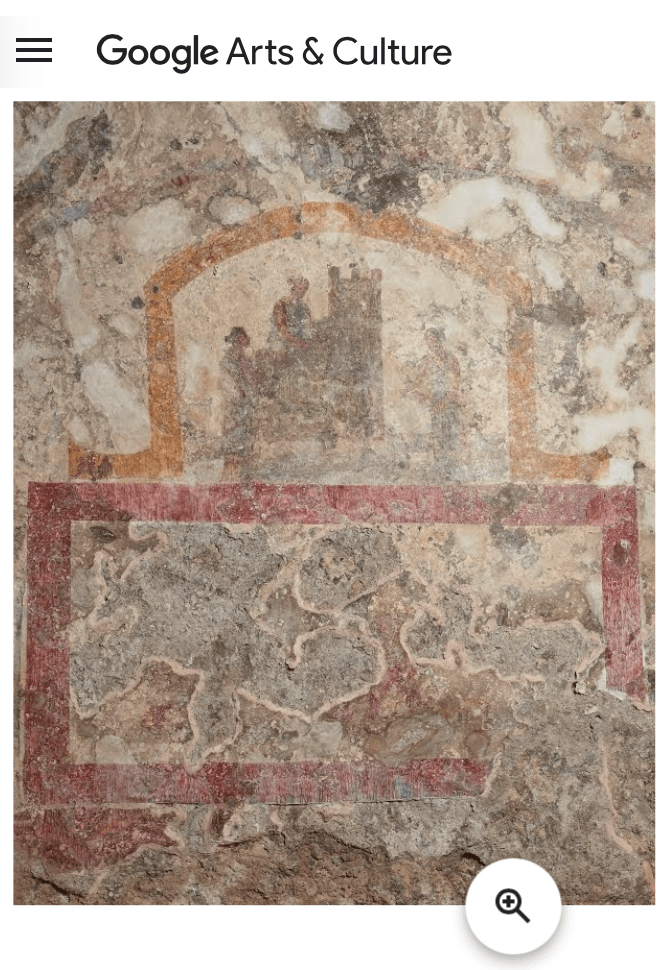
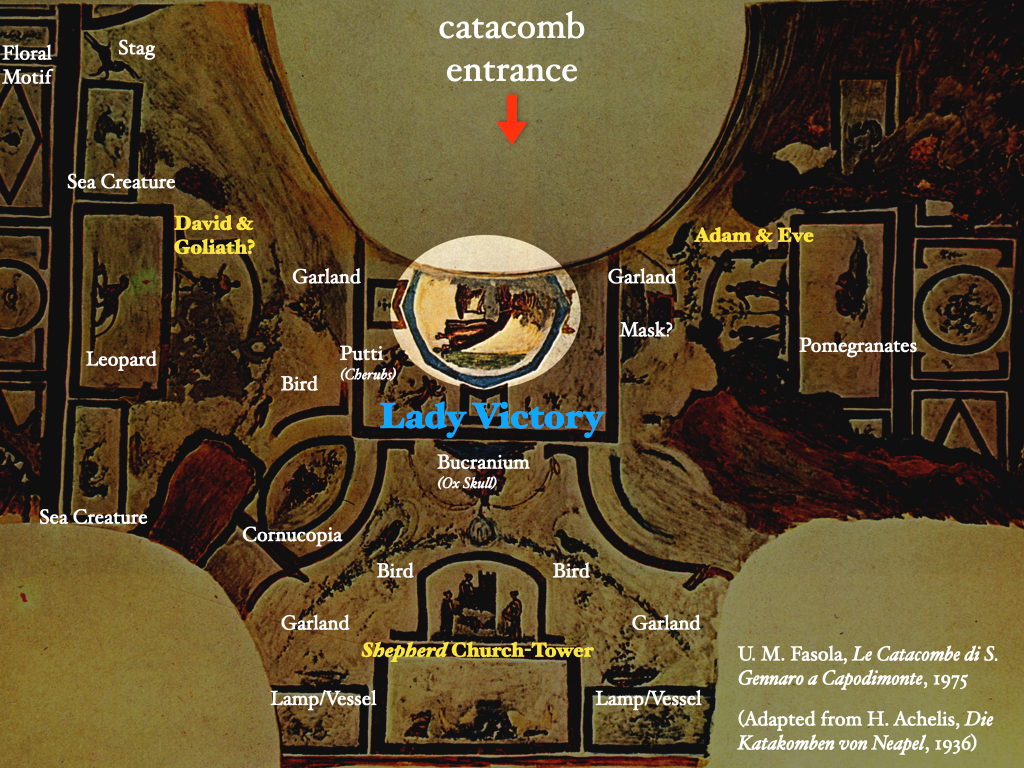
Perhaps the most interesting topic we covered concerned what I called the “anonymous indications” that The Shepherd was a valuable and integral component of early Christian piety. One of these in particular featured my analysis of the Church-Tower fresco (from Vision 3 and Similitude/Parable 9 of The Shepherd) in the San Gennaro Catacombs of Naples, Italy. While you listen to that discussion, it might be worthwhile to view the artwork in question from the third-century cubiculum of the catacombs via Google Arts & Culture, as well as to consider the wider scene depicted on the vault ceiling of “Room A1” as shown below from one of my lecture slides on The Shepherd’s reception in early Christianity. Moreover, you may be interested to “tour,” via Google Maps, the upper vestibule of the San Gennaro Catacombs using the links below.
This fresco from The Shepherd is a unique piece of artwork (a “unicum“) in early Christianity and has suffered from a lack of commentary or elaboration, particularly in English-language scholarship, for what it may suggest about the community that treasured Hermas’s book as authoritative scripture and commissioned its depiction in this sepulchral space. However, appealing to Robin Jensen’s guidelines for “visual exegesis” of early Christian art, I make the case, both in the book and our podcast conversation, that it should be viewed here—much as the Church-Tower functions in The Shepherd more broadly—in an aspirational, salvific context. In other words, we should view the individuals buried in this underground tomb as wishing to become the very stones of the tower, as the Lady Church imparts to Hermas, and to achieve their placement within its mystical structure, perhaps by their embrace of virtuous traits and lives of virtue, as a portrait of their salvation.
I hope you’ll listen to the conversation between Jonathon and me via the embed above or links below, and thanks for reading!
Links:
- Google Maps: Room A1 (Catacombe di Napoli)
- New Books Network
- Apple Podcasts / Spotify
- Q & A about my Book
- Lexington Books/Rowman & Littlefield (my imprint/publisher)

 Robert D. Heaton, Ph.D.