Hazor Dig Report: Week Two

It has been nearly a week since I posted a new “dig report” blog post, and this has actually happened for several reasons. First, there has not been a whole lot of significance to report: our daily plan is to dig in a specific area, and call one of the dig directors over to our area if we find anything of significance. But, this is a vast oversimplification, and not reason enough to keep me from writing.

20120705-180206.jpg
A view from Tel Hazor to the northeast, towards Syria.

The second reason was that I became violently ill early Tuesday (Israel time), which was a combination of a bug going around the camp, some strange food Monday night, and perhaps a bacterium from drinking flowing water at one of the sites on Sunday. We have no way to know for sure now, but the good news is that I’m feeling 100 percent again! I stayed home from the tel on Tuesday and slept most of the day, but returned on Wednesday and again today. Hopefully, I’ll be back to normal for the rest of the dig, and the vacation afterwards. (Sorry for not telling you, mom! You understand, right?)

As a general word about my section’s progress, we have dug our huge area down to about knee-length depth, and we haven’t really found much of significance: simply a lot of pottery and a lot of bones, but even more pottery. What we have found continues to tell the same story: our section is full of both Middle and Late Bronze Age sherds of pottery, and it seems to have been a “fill” in the Late Bronze Age. For reasons unknown, of course.

Thursday at the Tel

I think I mentioned in one of my earlier posts that the section adjacent to ours has a thorough, well preserved mud-brick wall that may, in some way, connect to our section. The thought is that our section, since it is substantially lower than the mud-brick section, could contain part of a floor relating to the mud-brick structure. That theory could eventually prove true, because the diggers in the mud-brick section have come upon the top of a few pithoi (singluar: pithos), or large storage jars, that seem to be intact, at the same level, and therefore possibly sitting on a floor somewhere below. I didn’t snap a picture of the jars, but I did get a picture of Harel working at the mud-brick wall.

20120705-180107.jpg
Harel, an Israeli archaeology student, poses for me by the special mud-brick wall that has consumed a lot of the dig directors’ time and energy.

In my specific section, the day was unremarkable, in large part because we had so many bucket chains, not to mention a special “rock chain” because a group digging the south end of Area M deconstructed an area-wide stone wall. I believe I’ve also mentioned bucket chains before; we diggers line up in somewhat of an assembly line and remove our dirt by passing our buckets to a particular location, which for us has generally been the south end of the area. A couple of times a week, a Caterpillar tractor will come to the tel and remove the big bags, which we call balot, for disposal elsewhere on the tel. Below is an example of one of the bucket chains in action.

20120705-180116.jpg
I snuck this picture while waiting for the bucket chain to begin from our northern end of the tel. I never quite know what end of the chain I’ll end up at: somewhere in the middle, on one of the ladders, pitching the full buckets up to the balot…

I took this photo from the northern end of my section of the area, while waiting for the bucket chain to begin in earnest from our buckets. Buckets are being chained up the area (from left to right in this photo) toward the balot, where someone is throwing them, and another is catching and stacking the buckets. We do bucket chains so often, and sometimes digging so sparsely, that perhaps digs should be renamed Old Dirt Removal for the sake of truth-in-advertising!

The last hour of the day was spent in another tour of the previous excavations of the area. While last week we received a tour from Amnon Ben-Tor of the eighth, ninth and tenth century (BCE) features of Hazor, this tour (led by Sharon Zuckerman of the Hebrew University) examined the Canaanite features of the Middle and Late Bronze Ages. This included a tour of the major temple on the site, from which I have numerous pictures up today on my Flickr site. Two of them, though, are below.

20120705-180135.jpg
This is the entrance to the royal, ceremonial temple of Hazor’s Canaanite era.
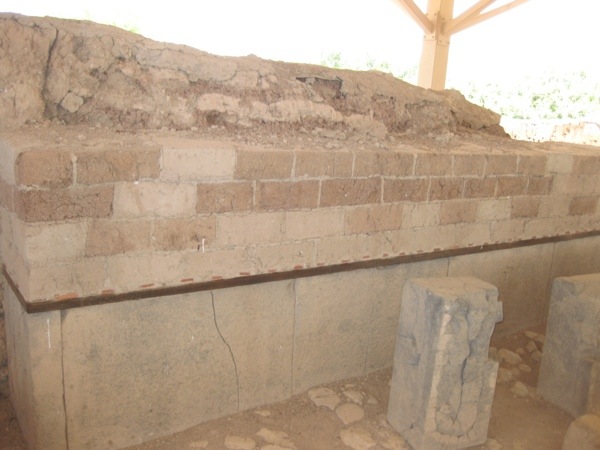
20120705-180159.jpg
This is an interior wall of the Canaanite temple, made of three different materials emblematic of similar Northern Syrian temples of the era: a basalt base, (Lebanese cedar) wood plank, and mud bricks. Inevitably so, a number of crumbling mud bricks are visible at the top of this wall.

Weekend Plans

The four of us North Americans (there are actually more – at least three other Americans and one other Canadian – but they are older and not as into adventure as us!) have planned a weekend trip of our own, separate from the South Africans this time. We will be renting a car beginning tomorrow afternoon so that we can go kayaking on the Jordan River on Saturday, followed by swimming and minor sightseeing around the Sea of Galilee. On Sunday, we will head to the west to see the Mediterranean, including Haifa, Caesarea (Maritima), and Megiddo. It will be nice to blaze our own trail this weekend, and especially to just take it easy on Saturday along the water.

My intentions could change, but I don’t see myself posting an update tomorrow after the dig. I hope everyone back home had a good 4th, and will have a better weekend!

Weekend Update: Galilee Edition

This weekend I went on an unguided bus tour with the South African group around significant sites in Galilee, including Nazareth, Sepphoris, Cana, Tel Dan, Banias (Caesarea Philippi), the Mt. of Beatitudes, and Capernaum. I ended up taking a ton of pictures, from which I posted 83 to my Flickr Photosteam! Since this post will not do the tour justice, I highly recommend that you also view my photos in their entirety, from both Saturday and Sunday.

***********************************

20120703-120825.jpg
The Sea of Galilee and its northern coast.

My fellow diggers for these three weeks at Tel Hazor are quite varied: young and old, male and female, those pursuing or holding degrees in Biblical Studies, Archaeology, etc., and those not doing so, and from a crazy array of countries: the United States, Canada, United Kingdom, Belgium, Denmark, Finland, Italy, Germany, Australia, New Zealand, South Korea, China, Israel, and probably some others that I’ve forgotten by now. But by far, the largest contingent of excavators is from South Africa! The 19 or so of them planned to hire a bus driver for the weekend to go on an unguided tour of mainly Christian sites around Galilee, and they offered to take others along in order to spread the (relatively inexpensive!) cost among more people. Along with the other three in my North American posse (more on them later), I decided to tag along and see what I could see.

Our first stop was Nazareth, where we visited the Basilica of the Annunciation and a reconstructed first century village, based partially on archaeological finds in the area. Then we went to Sepphoris, a Hellenistic Roman town with which Jesus must have been familiar as a seat of empire close to his Galilean home. There’s even a possibility that Jesus, as a carpenter/stonemason/builder with his father Joseph, may have helped in the reconstruction of the town in 19 CE. Anyway, Sepphoris (Zippori to the Hebrews) is perhaps best known for its majestic preserved mosiac floors, like the one below.

20120702-192018.jpg
This mosaic of a warrior is among many in Sepphoris.

After spending a good amount of time in Sepphoris proper, we left the heart of the town and visited the excavated water system outside of the city. Here I am squeezing myself through one of its smaller points!

20120702-192107.jpg
Rob in Sepphoris’ water system.

After Sepphoris, we visited Cana, which was uneventful and unexciting except for a Filipino nun calling Gabriel and Katie prostitutes for the clothing they were wearing. This is about how Saturday ended.

Sunday started off with a bang at Tel Dan, which is referenced in the Bible numerous times as the northernmost site both in the United Monarchy (from Dan to Beersheba) and the divided kingdom Israel (from Dan to Bethel). It’s an important site for several reasons. First, it sits along an international roadway leading from the north down into Samaria and Judah, and is therefore an early warning system if any enemies are planning to attack the cities to the south. Second, Dan is the beginning point for the waters that run into the Jordan and the Sea of Galilee, and therefore, supply all of Israel with its mayim. If you control the water system at Dan (along with the rest of Dan), you basically own Israel.

While at Dan, we visited the nature preserve maintained by Israel’s Parks System, and stepped into the freezing cold waters that originate from the snowmelt of Mt. Hermon, which eventually feeds the Jordan. We also went to the high place constructed at Dan, which was fascinating in its size and scope. Just past this, we (the four of us North Americans, who separated from the main group to take a more vigorous tour) posed for a photo in front of Mt. Hermon!

20120702-192135.jpg
Meet my group of good friends from the dig team: Gabriel (West Virginia), Katie (Newfoundland, Canada), and Cory (Ohio).

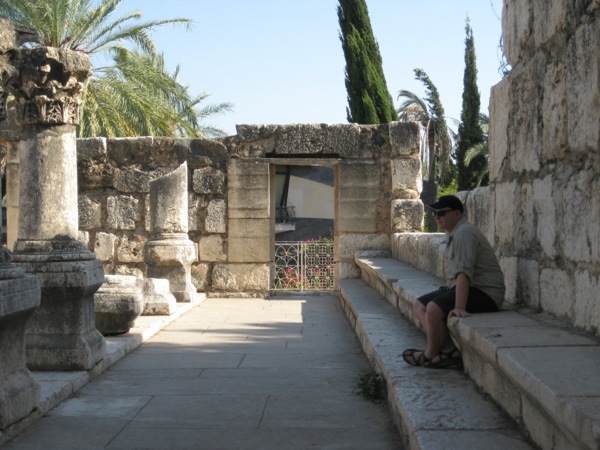
At this point, since my time to blog is now getting short, I will close with a summary of our travels for the rest of Sunday: we walked around Banias (and the region called Caesarea Philippi in Mark and Matthew) and then dropped down to the Sea of Galilee for the Mt. of Beatitudes and Capernaum, where Jesus and Peter spent a lot of time. In fact, here, the home traditionally associated with Peter’s mother-in-law is commemorated with a church that looks rather like an alien spaceship landed atop it. That UFO church is just visible in the doorway of Capernaum’s synagogue, at which I am seated below.

20120703-120532.jpg
Listening intently in the synagogue at Capernaum.

Hazor Dig Report: Days Four and Five

You may have realized that I didn’t post an update related to day four of my dig here at Hazor, as there was very little of significance to report. I woke up Thursday very well rested, as I was unable to stay up and watch the Euro match the night before–and therefore was in a great, peppy mood to begin the day. (Well, I was as peppy as one can be at 5:00 am.)

I also worked harder on Thursday than I had on the previous days, which was evidenced by the regular fountain of sweat pouring from my face. I feel like I should come back home ten pounds lighter or so, given all of the sweating, digging and heavy lifting I’ve done so far.

One of the positives on Thursday was finding a rather large potsherd, pictured below. Of course, we find hundreds (or even thousands, depending where we’re digging) of sherds in a given day, but some are recognizably more special at the outset given their size or the presence of some unique feature, like designs, or the sherd’s location on the piece of pottery. Especially interesting are pieces of the base, handle, or rim, by which it becomes easier to understand the function of the pottery, its classification, and, perhaps, its rough date of manufacture and use.

20120629-171228.jpg
Thursday’s find: the bottom of a vessel.

The sherd pictured above was found lying face down (base up), such that the first clue I found was a circular object and a small depression. I knew the sherd could not be too big (or completely intact) given that it was nestled next to a large rock. In the end, I thought this could have been a bigger chunk of pottery, but it still was probably my group’s most interesting find for the day.

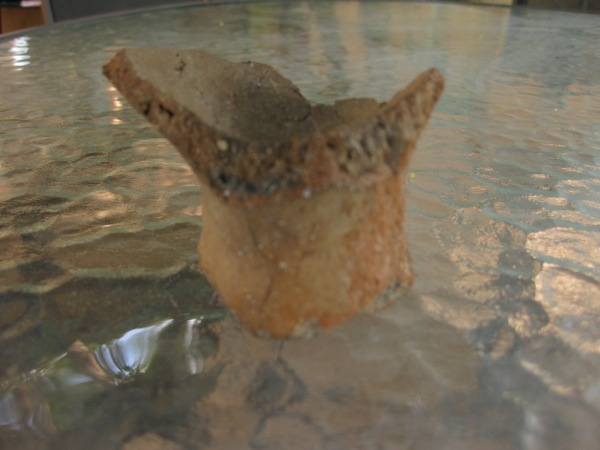
Fast forwarding to Friday, I found another interesting piece of pottery. This, pictured below, is the neck piece (not a scientific term) of a chalice, which is a stylized cup that is often used ceremonially or ritually. One would normally hold the chalice by this neck piece. I found it quite by accident–I didn’t see it immediately while I was digging with my pick, but when I was shoveling a mound of loose dirt into a bucket. Unfortunately, we have found no similar pieces that could allow us to reconstruct the chalice further. It was likely demolished, but this beefy piece survived the 4,000 years or so since the Middle Bronze Age.

20120629-171243.jpg
Friday’s find: the neck of a chalice.

Thus ends the fifth day, and first week, of the dig. It was an exhausting (but exciting) week!

*********************************

The evening lectures began this week on Wednesday, with a general introduction to the excavations at Hazor led by Amnon Ben-Tor. Much of the information was a recap, given that I had read plenty of articles on my way over, but just like the tour he led of the site, it was enthralling to hear it from a source that has been present at Hazor since the late sixties. More interesting was the next evening’s introduction to pottery reading, where we learned how to determine if a given vessel is open or closed, and what general function it would have served (storage, cooking, food presentation, etc.).

This weekend, I am traveling out of the kibbutz with a group of South Africans that has reserved a bus to several biblically significant sites. On Saturday, we will head north to Dan, Caesarea Philippi, Capernaum, and other places around the Sea of Galilee. I will definitely go with them on this trip, but I haven’t committed yet to Sunday, when the group is planning to take the same bus toward the western coast of Israel. Either way, I will surely have some great pictures from the weekend, and likely a blog post to accompany it. Until then, thanks for reading!

Hazor Dig Report: Day Three

Though it is now officially day three of the dig, it was, for all intents and purposes, day one of the actual digging. We are now beyond the winter wash and into the layers that we wish to save and study.

The day began with the construction of our shade over Area M. The shade netting, which we repaired from the previous season’s holes yesterday, had to be stretched over the area and tied off along the fence surrounding it. We then set some support poles in place to make the shade more taut. Below is a picture of the shade now covering the dig area.

20120627-164444.jpg
Don’t be too baffled by the South African flag; nearly half of our excavation group traveled from there.

I was assigned for the day with a handful of people from South Africa to a section within Area M referred to as the “plaza.” This section has baffled the dig directors since last season, when a relatively early mud-brick hut was uncovered in a higher layer of an adjacent section. This is problematic because a general rule of archaeology says that the deeper you dig, the deeper you go back into history. However, the opposite seems to be the case in this “plaza” section: it has showed signs of being later (more recent) than the surrounding areas which are above it. The question is: how much later? The dig directors were adamant that any Iron Age materials found in this section would be very problematic, causing us to jokingly say, with our novice knowledge of prehistoric pottery, that every new find displayed Iron Age characteristics.

20120627-164242.jpg
Here is the vicinity of my Area M section. More specifically, I worked today mostly in the upper right quadrant of this photo.

The general method of digging today involved picks, hoes, shovels and buckets. We took off a layer five centimeters (two inches) deep from our section, being sure to collect all the pottery and bones from our section in a pre-defined bucket, so that it could later be studied and easily connected to the place in which it was found. Five centimeters may not sound like much, but collecting the artifacts and disposing of the common dirt mix from five centimeters, when multiplied by the entire Area M, will consume an entire day.

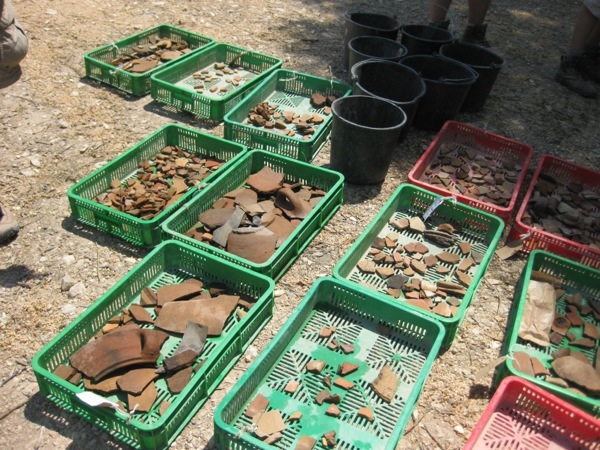
Because this was the first “actual” day of digging, it was the first day of pottery washing. Thus, when we cleaned up the dig area, we relocated to a new place under some trees to wash everything we had found during the day, per the normal routine.

20120627-164252.jpg
These pottery crates include most of the finds by the dig group today.

Thus ended our day, and we were soon after bussed back to the kibbutz from the tel. As for now, I must get something of a nap, because tonight we will have our first evening lecture, followed by a Euro 2012 football match that I hope to stay awake for. Day three of fifteen, complete!

Hazor Dig Report: Day Two

Some photos from the day are below, but many more can be found on my Flickr Photostream! Be sure to look at both!

********************************

Day two was another strange day on the tel. I’m not even certain it is appropriate to call this a dig report, given that much of the day was spent doing other things.

Anyhow, upon arrival we were split among two groups, and my group was instructed to mend holes in the large shade-netting that we intended to suspend over the top of Area M. Though we did so, this was a difficult and annoying process: using thin metal wire and pliers, we sewed holes shut to the best of our abilities. However, some holes were more like long rips, so it’s fair to say that we did some delicate suturing of last season’s surgery.

20120626-163916.jpg
This is the large shade netting that we had to repair early this morning.

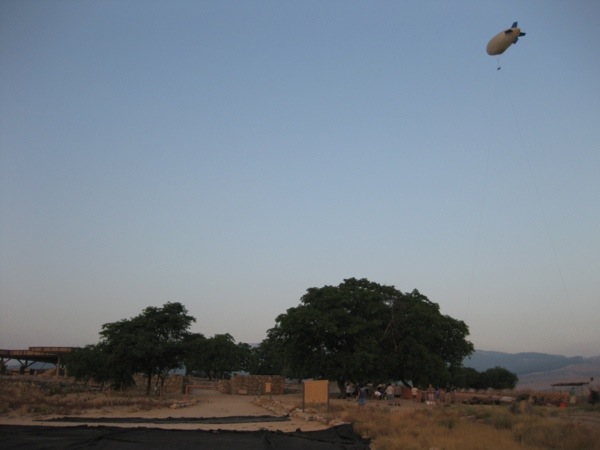
At this point, the truck towing the arial photography balloon pulled up, and we finally had something to take our minds off the shade netting repair. The balloon, and its operation, was rather cool: the operator held a machine that looked rather like an Atari, with buttons, dials, levers and a screen through which he could control the flight of the balloon and the orientation of the camera. Below is a photo of the balloon in action high above Area M.

20120626-164240.jpg
Area M is directly below the photography balloon.

After the balloon show was over, we found other, more badly damaged pieces of shade netting that were to be used for other areas of the tel this year. So, our annoying job wasn’t quite over; it was just getting started!

Finally, I was able to descend the ladder down into Area M, and the brief spell of digging began. Using picks and hoes, we de(con)structed the top layer of a couple of walls, shoveling the dirt and rocks into buckets as we went. While doing so, one of my dig partners discovered a couple pieces of an alabaster jar, and not far from us, another digger found what seemed to be the nipple-shaped lid of the jar. Unfortunately, I did not snap pictures of these.

Shortly hereafter, at approximately 9:15 am, came the call for breakfast, and after breakfast, it was announced that Professor Amnon Ben-Tor, who has led and been part of the Hazor excavations for 30-plus years, would lead us on a tour of the tel. How often does one get such an experienced tour guide? Our tour was fantastic, as my Flickr Photostream might show (hint, hint).

20120626-164340.jpg
A biblical olive oil press.

Above, for example, is an olive oil press found in a traditional Israelite home (the wooden rod, rope, and baskets are all modern implements added to show how the press would have worked). Our guide explained that the olives would have been smashed into a pulp in the container to the left, before being placed in the baskets and weighed down over the course of a few days in order to collect the oil in a floor-level jar.

20120626-164355.jpg
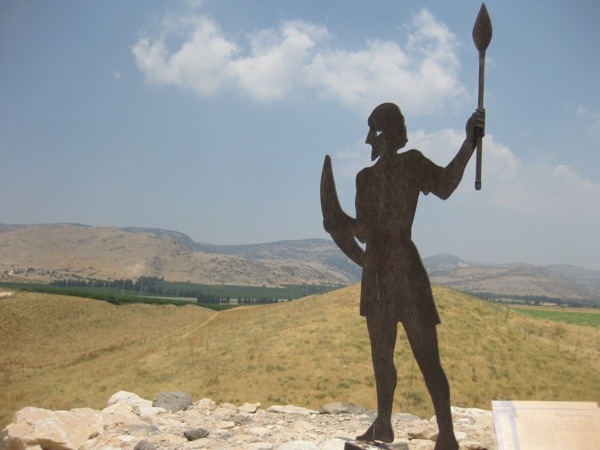
The Hazor warrior!

And this “Israelite” guard keeps watch over a tower on the western edge of the tel, just outside of the city walls. Ben-Tor explained that it was placed here after a long battle with the Israeli government–over the specific aesthetics of the warrior–in order to attract passers-by to the site.

The tour eventually finished, but we were prevented from doing any actual digging back in Area M because of a lengthy clean-up operation involving a tractor, some large rocks, and the balot, which are large bags into which we had been dumping our dirt and rocks. The tractor will not be at our disposal every dig day, so we had to use it to lift away our junk while it was present today. Thus, our last job of the day was to remove our tools from the dig location by the use of an assembly line-like “tool chain,” storing them in the coffins at 2012 ground level. Day two of fifteen, complete.

********************************

In all honesty, I’m not sure I will always have enough interesting material for a “dig report” blog post every day. In some cases, I will have to write about other topics, if I write at all. My wife has suggested a few different topics, including kibbutz life, the Israeli food, and something on the other people with whom I am digging. To me, these all seem like great ideas, and I will incorporate them in a post eventually. Let me know if there is anything else along these lines you’d like to read about in the comments below!