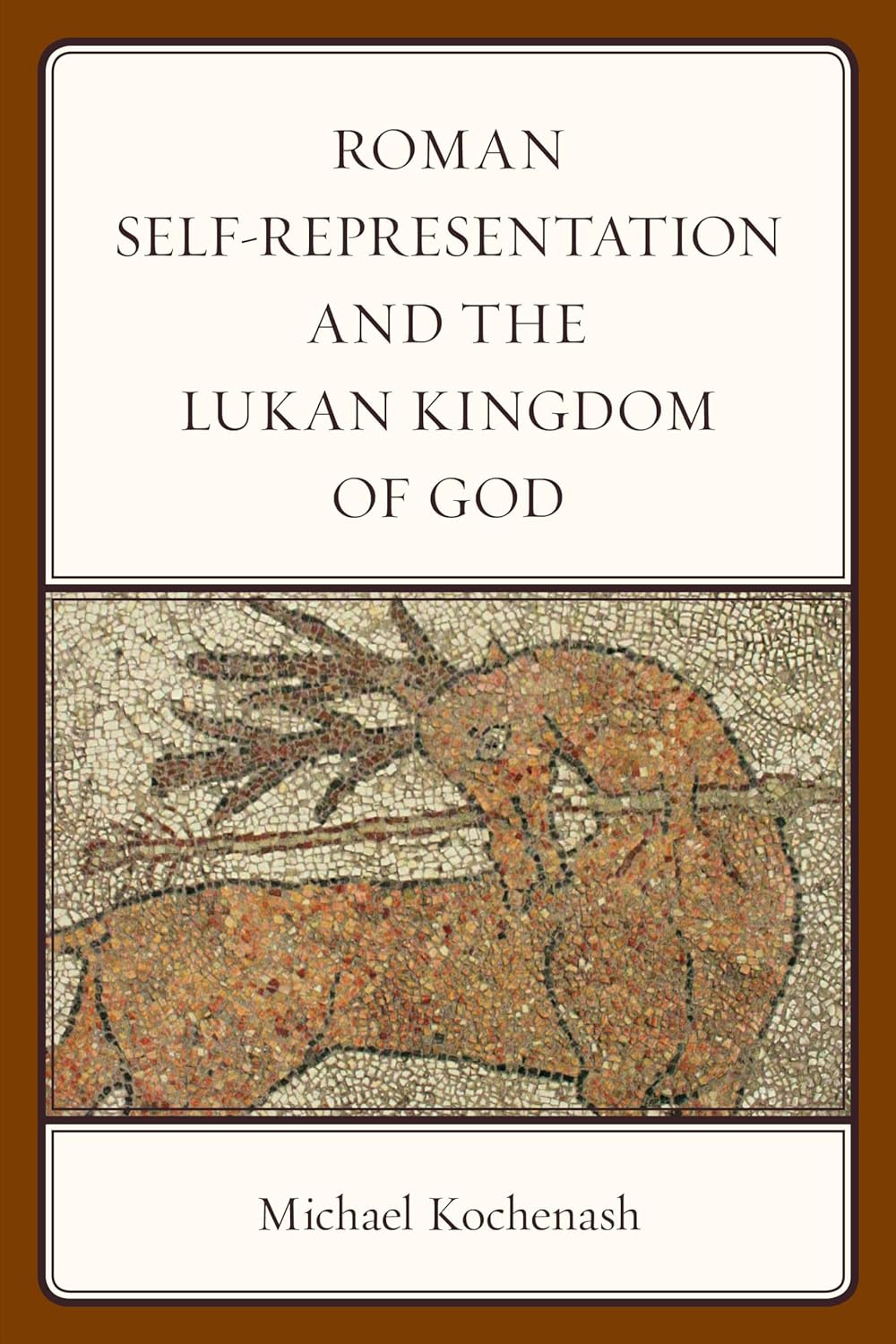
My latest book review was published this past Leap Day on Michael Kochenash’s revised dissertation, Roman Self-Representation and the Lukan Kingdom of God (Lexington Books/Fortress Academic, 2020), by Rhea Classical Reviews. Please follow the link to read my review of Kochenash’s book, which explains his method and the connections he makes between Rome, Aeneas, Jesus, Octavian, and a number of other worthy and interesting subjects.
This review continues a theme of my fascination with Luke-Acts, which collectively looms large over the New Testament as a whole, but also on the typical ways that Christians have understood the history of the Jesus movement. Kochenash has written extensively on Luke’s contributions to Christian knowledge, some of which may be the author’s innovations. Independently of this, mainly for lecture preparations on Luke-Acts and the Synoptic Problem, I have been recently dipping my toes into the ouevre of Michael D. Goulder, who coins an important term for Luke’s compositional activity that I have found appealing: scriptural embroidery. In fact, I have written a short article, appealing to the bygone scholarship of Goulder, that may be of interest to scholars wishing to introduce a non-Q perspective into their Gospel of Luke readings while also explaining his method on a characteristic Lukan parable, that of the Good Samaritan.
Preface: Mike, if you happen to read this, I’m sorry that you became Example 1-A for my lament. You are a public servant, however, and I just happened to see your ad one too many times. Good luck in the race, and I hope you’ll give some thought to that He-who-made-a-way guy, if elected.
How does a particular amalgamation of mainstream politicians become so appallingly atrocious that I will likely vote in the upcoming gubernatorial election for a scruffy-bearded ex-contestant on Survivor, CBS’ never-ending reality show that must nowadays refer to its few remaining viewers? Well, unfortunately, I can’t say much about the systemic causes of the ever-deepening rot of America’s political ruling classes/parties, but I can gawk at and lament about the trainwreck produced incessantly by the election cycle’s inescapable death march toward November.
Meet Mike Pence, Indiana’s very own Flat Stanley, a shockingly boring and vanilla Republican candidate for governor, and the current Congressman from the state’s sixth district in the U.S. House of Representatives. Go ahead, clickthrough to his website; my post will still be around when you wake up from your nap.
Recognizing that some numbers sound like English words, Pence’s campaign, ever-so-cleverly named “Pence4Indiana” on YouTube, is responsible for this excruciatingly generic drivel of a “campaign ad.” It airs on just about every commercial break during the Olympics, but I’ll only ask you to waste 30 seconds of your time watching it.
Great, eh? Indiana has somewhat of a significant National Guard, and some people choose to serve in it. Good for them. Nevermind that the National Guard is not the active-duty Army, even though our military adventurism of the last decade turned them into that on a de facto basis.
But this post is not about the people who choose to join the National Guard or any other branch of the armed forces, their multitude of reasons for doing so, or the like. It is about the jarringly annoying way politicians use rhetoric for perceived gains, especially when weighed against banal statist obeisance to the supposed religious principles of the majority.
(Please, read that previous paragraph again if you have to. This is not an attack against people who join the armed forces. It is a much, much broader lament about a society that both desires and permits injustice and rewards politicians who fail to question the reign of death posed by our foreign policy on the encouragement of the military-industrial complex and the fear machine. Deep breath.)
************************
Let’s start with the absolute basics. I was elected as a delegate earlier this year to the Indiana State Republican Convention, and if you know anything about me at all, you know that I went solely in support of Ron Paul. The state party did everything in its power to ensure that our voice was silenced, using its night-before-the-convention emendations to parliamentary process to silence the strong minority of us who were attending not to schmooze with powerful people in button-down shirts, but to challenge the legality of a clause preventing any debate about party-appointed nominees. Instead, we could only vote yea or nay to their slate of party-line-towers hoping for political careers. This, America, is how you get your politicians.
Anyway, on the second day of the convention, we had the distinct privilege of listening to people speak for 3 hours. These people included one Mike Pence, the party’s uncontested candidate to replace Mitch Daniels as governor. Here’s part of Pence’s riveting speech that day, just after he spoke about “faith,” “morals,” and how to “renew our land”:
Two centuries ago, as our pioneer forebearers labored to carve a home in the woods that was Indiana, they did not labor alone. And I believe with all my heart that He who made a way through that dense and dangerous forest, through harsh elements, toils and snares is with us still today.
I start with this not because those comments sounded particularly stupid to me at the time, but because his snoozer of a speech as a whole, and these excerpts, reveal enough about the candidate’s perspective to illustrate a basic theology: God is with Us, Jesus is on Our Party’s side, He will help us navigate this stormy political climate, and it’s a Good Thing for my candidacy if I sound this way when I speak to Hoosiers.
************************
Now, back to the advertisement.
I’m not sure it’s fair to label it as an advertisement, actually. The information it contains is not especially relevant to Pence’s gubernatorial campaign. If I was in high school again and asked to judge the few statements that Pence makes for their communicator’s purpose, I would have to say “to inform.” Of course, Pence did not sit down and film an ad, involve creative firms to produce an ad, and pay immense sums to NBC Universal to air an ad every waking hour of the day just to inform Hoosiers that their National Guard is the fourth largest in the country. There are deep, persuasive elements at play in the ad, and Pence wants you and I to know that he thinks about the American military exactly as we common people do.
As if we had any question about that.
But beyond the feel-good background music and the silhouetted imagery of glorious assault rifle barrels, what do we learn about Pence as a candidate here, other than the fact that he doesn’t mind taking regular Congressional junkets (on the American taxpayer’s dime) as photo ops to shake hands with our troops?
Considering the placement of the ad–during Olympic commercial breaks when our pro-USA excitement is generally pretty high–can we accept the its intentional nationalism (at best) or blatant jingoism (at worst)? Isn’t the Olympics supposed to be apolitical, to foster a sense of respect and togetherness for humanity, and aren’t we supposed to be affected by seeing the faces of The Other who, though he or she happened to be born in some other region of the world, wishes to live a fruitful life, just like us?
How do we square the dichotomy of military bravado with the command to love one’s neighbor, and especially the example of nonviolent resistance to oppression and corruption given by one Jesus of Nazareth?
How is signing on to destroy human life, or worshipping those who do, a “blessing”?
What do “service” and “sacrifice” actually mean?
************************
I’ve often thought that we, as American Christians, should be far more forgiving to Pontius Pilate. After all, he was just a lad born into the undisputed, uncontested, unchallenged and unmistakeable ruling empire of his day; the world had never before seen such a thing as Rome. Personally, he had aspirations of power and political greatness, and was doing his best to work his way up the chain of command, even if that meant toiling as Prefect of Judaea. Now, I don’t have any insider access to his personal thoughts, but I think it’s fair to say that he probably went about his life without ever questioning the morality of the use of force against oppressed peoples, which meant he had no problem using brutal force against those who his empire dominated violently, even for the most benign of reasons. He, like Rome in general, was not especially critical about who made their way onto his kill list from these inconsequential lands.
Through the armed-forces-worship, this is exactly what I hear from Pence’s advertisement. Only, it’s not in an explicitly abhorrent sort of way, whereby he cheerleads the deaths of people who happen to be on the wrong side of our armed drones, or superimposes the number of dead Middle Easterners all over the screen.
It’s in an I-know-the-American-people-are-totally-cool-with-this sort of way.
The bushes in front of my apartment have been overridden with cobwebs this summer because until just recently, central Indiana hadn’t received much in the way of rain.
As it turns out, the cobwebs are even thicker on my blog. Wow, no posts since March 14? If we’re counting by the accumulation of U.S. government debt since that time, that’s over 400 billion dollars ago!
Also since that time, the spring semester came to a close (complete with 2.5 weeks of absolute frantic chaos), followed promptly by a summer course and thesis proposal that, when combined, felt like a death march. I’ve enjoyed my recent freedom from coursework, though in that time I’ve dedicated several hours a day to learning French. (Oui, je parle le français maintenant!Vive le France!) The language is necessary for my future pursuit of doctoral studies, but it may come in extra handy if Lauren and I decide to pursue the Peace Corps before that time. Now, there’s less than a month until the fall semester commences, so it’s time to savor every remaining day.
But the major benefit to the summer has been the ability to clear required reading off my bookshelf and make some room for “pleasure” reading. My pleasure reading this summer has consisted of three major categories: theology (of course), politics, and the complexity of the human brain (yes, it’s way out in left field, I admit). My summer reading list:
Love Wins, Rob Bell
Jesus Before Christianity, Albert Nolan
The Evolution of Faith, Philip Gulley
Christianity Without Absolutes, Reinhold Bernhardt
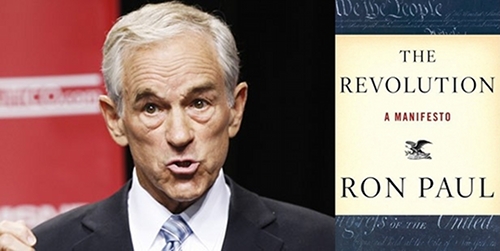
The Revolution: A Manifesto, Ron Paul
Liberty Defined: 50 Essential Issues That Affect Our Freedon, Ron Paul
Incognito: The Secret Lives of the Brain, David Eagleman
The Believing Brain: From Ghosts to Gods to Politics and Conspiracies–How We Construct Beliefs and Reinforce Them As Truths, Michael Shermer
That last one–by Shermer–has been entirely fascinating, and probably will require a serious discussion on the part of this “believer” whenever I happen to finish it. It’s long, challenging and intellectually stimulating, but in the end will be worthwhile.
But as the title of this post suggests, I’ve kept myself abreast of the financial Armageddon that the United States is quickly approaching next Tuesday. Actually, as we spend much more than we take in–to the tune of 40 percent of every dollar spent being borrowed from some other country like China–we’ve been approaching it for a while. It’s just been quickly accelerated since 2000 or so. And the things that Ron Paul wrote in his 2008 “campaign book” (of sorts), The Revolution: A Manifesto, make him seem like a prophet. I quote Dr. Paul at length:
Right now our government is borrowing $2.2 billion every day, mainly from China and Japan, to pay for our overseas empire. As our dollar continues to decline, thanks to Federal Reserve inflation, the American debt instruments that these countries are holding lose their value. We cannot expect these and other countries to hold on to them forever. And when they decide that they no longer wish to, our fantasy world comes crashing down on us. No more empire, no more pledging ever more trillions in new entitlements. Reality will set in, and it will be severe.
Our present course, in short, is not sustainable. Recall the statistics: in order to meet our long-term entitlement obligations we would need double-digit growth rates for 75 consecutive years. When was the last time we had double-digit growth for even one year? Our spendthrift ways are going to come to an end one way or another. Politicians won’t even mention the issue, much less face up to it, since the collapse is likely to occur sometime beyond their typical two-to-four-year time horizon. They hope and believe that the American people are too foolish, uninformed, and shortsighted to be concerned, and that they can be soothed with pleasant slogans and empty promises of more and more loot.
To the contrary, more and more intelligent Americans are waking up to the reality of our situation every day. Now we can face the problem like adults and transition our way out of a financially impossible situation gradually and with foresight, with due care for those who have been taught to rely on government assistance. In the short run, this approach would continue the major federal programs on which Americans have been taught to be dependent, but in accordance with our Constitution it would eventually leave states, localities, and extended families to devise workable solutions for themselves. Or we can wait for the inevitable collapse and try to sort things out in the midst of unprecedented economic chaos. I know which option I prefer.
I’ve come to the realization that the only thing really great about our government these days is the size of the growing monstrosity of a deficit. Ron Paul preaches a foreign policy of non-interventionism and a domestic policy of weaning ourselves off entitlement programs, abolishing the Federal Reserve and allowing free market economies to prosper without unnecessary intermingling. I’m convinced that his Constitutionalist ideas, whether they are adopted under a possible administration of his or by a like-minded individual, are the last shot we’ve got at regaining the greatness that once was the United States and curtailing our empire before it crumbles before us.
So really, read his book. Go to the library today and borrow it. Educate yourself and challenge yourself. You don’t have to agree with me, or Dr. Paul, but at least give him a shot. Because if there’s anything we know for certain, it’s that the establishment-fattening ideas of the last two administrations have not produced anything worthwhile. For a quick introduction to him, you may even like to give this recent interview he gave to PBS Newshour a listen:
I know people are fond of saying that he’s crazy (or maybe some other, more explicit manifestation of this idea). He seems crazy because what he’s saying is so different from everyone else in Washington. I’m probably crazy for believing that he can become president of such a mess. I do know that I’m willing to give the man a shot. He’ll get my vote in the primary and, I’m certain, a plethora of other support along the way.
But, I digress. In the days to come, this blog will once again light up with activity, as I have a number of papers long and short from the last 1.5 months of the spring semester that are certainly worth sharing. I’ll try to keep it light on the politics, I promise. The easiest way to receive these is to click the “Sign me up!” button on the right-hand border, just below the recent post list and the category cloud. Or you could subscribe to my RSS feed, or just look for my shares on Facebook and Twitter. Thanks for visiting, and au revoir!
Academically, this surely will not have been the hardest semester of my postgraduate experience, but it will probably come to be the hardest one logistically.
A squirrel hanging from a birdhouse has nothing to do with this blog entry, but it was one of the first photos that came up on a Google Image Search for “whew.”
The actual truth of the matter is that my semester ended eight days ago. But for the last week or so, we’ve been frantically packing our apartment so we can move to campus just after Christmas. I feel fortunate enough to blog about it all now that I’m with family to celebrate Christmas or Winter Solstice or whatever it is that we celebrate this time of year (more on that tomorrow).
But starting next semester, I won’t have to wake up so early for my early classes! I’ll still wake up early, and hopefully go through the gym routine before classes begin, but I’m most excited about not having to waste time (and gas) on the drive to and fro. That will free up time to do coursework at a more reasonable hour, cook dinner more often, sleep longer, devote some time to a community ministry and hopefully have a free weekend every now and then for some recreation. Like all of that will ever happen like I imagine.
To recap from the year that was, all of my classes ended excellently… a 4.0 semester! I certainly didn’t expect that, but I’ll take it and try to repeat it again in the spring. Two of my classes – Greek and Old Testament – essentially continue in the semester to come, and to that I will add the history of the Church of God movement (I’ll call it CHOG History) and “Christians and Old Testament Theology,” which has interested me throughout the past semester of Old Testament class. It will be exciting to interact with the beliefs of the Israelite fathers and prophets and understand how Christians can more faithfully apply that to a well-rounded base of faith.
Other than the big post-Christmas move, I have two major personal goals during the break. Those are…
Read for fun! I have been reading Jesus the Riddler by Tom Thatcher for the greater part of the semester, and am almost finished with it. It has been a great read, even if my wife has ridiculed me for enjoying such “boring” books. The good news is that I’ve also checked out Thatcher’s other book, Why John WROTE a Gospel. I have another about the history of Messianic expectations, but I probably will not get to that until next semester.
Apply for funding to go to Israel this coming summer. Through a fellowship, Anderson University funds a student to travel to Israel for an archaeological dig each summer, and I want to get that either this summer or next… but preferably this summer. I have picked out an interesting dig site (Tel Hazor) and need to fulfill the application requirements, including an essay, before January 15.
And besides those things, it would be nice to add some new and fresh content to the blog for the new year. I’m sure I’ll hammer out a blog post or two once I’m settled in Anderson!
You are reading Part 4 of a term paper for my Church History class. And what fun it was to write! If you like learning and reading about heresy, you might enjoy it as well. If new and different perspectives turn you off, then I don’t imagine continuing to read this will be much fun.
—————————————————————-
IV. Personal Reflections
As much as such restraint is humanly possible, I have striven to reserve any personal opinions about the Ebionites and those beliefs attributed to them by church fathers from the preceding sections of this essay. On the other hand, in no way do I claim that this section of the exposition will retain a sense of objectivity. For one, I firmly agree that “there is nothing wrong in a natural scholarly sympathy for minority groups that were not destined to be history’s winners.”[1] Rather than existing solely as an interesting factoid in the annals of Christian history, the Ebionites and similar groups labeled as heretics from an early date deserve a voice and a chance to be judged on their merits. Personally, with the extraordinarily limited way in which Jesus was revealed to the world, I furthermore believe that the Ebionites deserve to be praised for their audacity to dissent and to be pardoned for their beliefs, even if they do not align to God’s ultimate, absolute truths. It seems that the Ebionites placed a premium on being intentionally poor as a method to adhering to both Jewish Law and Jesus’ message; this action likely developed more intentional, loving communities in spite of the heresiological claims of early church fathers.
Moreover, today’s Christians must admit that proto-orthodox scribes and proponents had a hand in altering Scripture to suit their beliefs, much as was ascribed to Ebionites and Marcionites. In the aforementioned example regarding the voice from heaven at Jesus’ birth, the Lukan text was eventually changed from “today I have begotten you” to the Markan counterpart of “in whom I am well pleased.”[2] While the Ebionite belief about following Jewish Law may have been a matter of opinion, the adoption of Jesus at baptism was well supported by the original version of Luke, part of which made its way into the Ebionite Gospel. However, once this change was solidified, it was also used to call out heresy among so-called Roman “adoptionists,” who were eventually excommunicated from the church.[3]
Throughout the course of my study of the Ebionites, I continued to find myself increasingly sympathetic toward their points of view. For example, I have always recognized the significance of Paul as a normative and formative writer for the early Christian church. Unfortunately, the ferocity with which he made his claims left little room for nonconformist opinions, serving not only to squelch the perspectives of those who could have been more authentically Christian, but also encouraging equally ferocious and self-serving Deutero-Pauline material, which included unfortunate admonitions about the roles of slaves and women (1 Tm 2:11-15). Additionally, it is inescapable that Paul had no direct, personal knowledge of Jesus. Therefore, I recognize Paul as a commentator on the life of Jesus best viewed on a level playing field with similar writers, his Damascus Road event notwithstanding. In a sense, this viewpoint makes me an Ebionite; furthermore, I am sympathetic to the reasoning behind Ebionite adherence to Jewish Law.
V. Conclusion
The Ebionites were always a minority group. Perhaps at one point or another they became enough of a minority group—either by their number of followers or by possessing such threatening theology—to encourage early church fathers to write about and denounce their beliefs, but let’s be honest: the Ebionites never had a chance at flourishing as a majority religion. In proclaiming his kingdom message, what Jesus may have intended as a defiant but peaceful Jewish revival eventually became the majority religion of the world, including its most powerful nations. And these empires—whether Roman or American—were never bound to adopt intentional Ebionite poverty and strict adherence to Jewish Law on a large scale. “Had Ebionite Christianity ‘won’ the internal battles for dominance, Christianity itself would probably have ended up as a footnote in the history of religion books used in university courses.”[4] While it feels good to be in power, perhaps Judaism and Christianity alike are better suited as marginalized, minority, mustard-seed-like movements taking over individual patches of land at a time rather than occupying the ivory towers of official (or unofficial) state religion.
Theissen writes, “As a renewal movement within Judaism, the Jesus movement was a failure.”[5] In their own battle for acceptance and survival, the Ebionites also failed. In that sense, Jesus was an Ebionite, too.
[1] Skarsaune, “The History of Jewish Believers,” in Skarsaune and Hvalvik, 754.
[5] Gerd Theissen, The First Followers of Jesus: A Sociological Analysis of the Earliest Christianity, trans. John Bowden (London: SCM Press, Ltd., 1978), 112.


 Robert D. Heaton, Ph.D.