Ruth and Boaz Doing Whatever on the Threshing-Room Floor

For Old Testament, we students reflect weekly on “some topic, aspect or concept” from the volumes and volumes of assigned reading. I am limited to one single-spaced page each week, and in every case I’ve been forced to cut myself off from writing. So read knowing that my thoughts are manifold!

If you are interested in more selections from my School of Theology Coursework, follow the link to the category of SOT Coursework. I have also set up a new category for these Old Testament reflection papers called OT Weeklies. If all goes well, each new reflection paper will be posted automatically at 2:00 p.m. each Monday, when my Old Testament class convenes.

What follows is my reflection paper from the week of November 1. Enjoy!

————————————————————————————————–

The account of Ruth at the threshing-room floor (Ru 3:6-15) strikes me as a bizarre, logic-defying story. When considering whether the narrative is a historically accurate representation of an actual interaction between Boaz of Bethlehem and Ruth the Moabitess, I could not help but conclude that I was actually reading a cover-up for sexual impropriety. How could an unmarried, drunk forty-something[1], upon awakening up from his euphoric stupor, resist a foreign woman who both uncovered and took rest by his “feet,” a term used and understood to mean “genitalia?” Was he plagued by a hangover? Surely something mischievous may have taken place; even Ruth and Boaz were concerned with how the scene might appear if gossip reached the town square (Ru 3:14). But in attempting to research further support by which to decode this chapter’s sexual innuendo, I found that the author of Ruth constructed a literary masterpiece contrastive to Genesis 19 in order to exemplify both Ruth and Boaz as law-abiding all-stars. This reflection paper will elaborate on the fantastic hidden elements of Ruth 3.

A mountain of research suggests that chronologically, thematically and grammatically, Ruth may have originally been included at the end of the book of Judges, and was only removed later to form its own book.[2] But for Warren Austin Gage, lending the most credence to this theory is the correlation between the sin of Gibeah (Jgs 19) and Ruth 3 as a unit reflective of Genesis 19.[3] For example, in the stories of both Gibeah and the destruction of Sodom (Gn 19:1-28), men of the city seek visiting male strangers for sexual gratification, only for the host to offer two women as a substitute, “suggesting that the author of Judges intended his hearer to identify the sin of Gibeah with that of Sodom.”[4] That leaves the account of Lot and his daughters in their cave as a parallel to Ruth and Boaz at the threshing-room floor. If we take the texts at face value, Lot’s daughters act unlawfully, while Ruth retains her honor. Gage especially appreciates that Lot’s daughters receive their father’s seed, while Ruth receives only Boaz’s grain.[5] Boaz redeems Ruth, but in a sense, her upright actions both redeem and set the proper example for Moab, which had its beginnings in the incestuous act of Lot’s conniving older daughter.

Upon returning to Bethlehem, Naomi takes it upon herself to resolve basic problems through the instrument of Ruth. The first problem – a lack of food – is solved by sending Ruth to glean for barley in Boaz’s fields, which is consistent with Mosaic Law (Lv 23:22). On the other hand, in order to solve the more difficult problem of offspring, Naomi encourages Ruth to approach Boaz alone at night on the threshing room floor while wearing her finest clothes, and only after he had partaken in food and drink. What she asks of Ruth in this case is entirely inconsistent with Mosaic Law, and Boaz is intricately aware of this.[6] Though he must wait until the following day, Boaz responds by addressing the legal proceeding at the town gate and by first offering both Ruth and the fields of Elimelech to the unnamed nearer kinsman (Ru 4:1-12).

What really happened at Boaz’s threshing-room floor? Did Ruth give him a biblical booty call? If she didn’t, would she have if Boaz told her to do so, as Naomi instructed (Ru 3:4)?  For the author, who must have been uniquely aware of the situation he was penning, these questions were apparently less important than presenting Ruth and Boaz as standard-bearers, as personified examples of Mosaic Law gone right. By design, Boaz is a covenant-keeper and kinsman-redeemer, whereas Yahweh rewards the submissive Ruth with a son, Obed.


[1] Victor P. Hamilton, Handbook on the Historical Books (Grand Rapids, MI: Baker Academic, 2001), 198.

[2] Warren Austin Gage, “Ruth Upon the Threshing Room Floor and the Sin of Gibeah: A Biblical-Theological Study,” Westminster Theological Journal 51, no. 2 (Fall 1989), 369-370.

[3] Ibid., 370.

[4] Ibid., 371.

[5] Ibid., 373.

[6] Charles P. Baylis, “Naomi in the Book of Ruth in Light of the Mosaic Covenant,” Bibliotheca Sacra 161, no. 644 (October-December 2004), 430.

Church Reformers Before Luther: St. Francis and John Wycliffe

I find that I do enjoy posting some of my regular coursework, whether or not it brings in the page views and comments! This post’s selection comes from my Church History course, and though the assignments for this class are more informal (in common language, etc.) than in Old Testament class, I do believe they are valuable in certain sense. It’s all about making the past accessible to everyone, right?

Please feel free to interact with this as you so choose! I hope everyone has a great Tuesday.

———————————————————-

This week’s assigned readings covered about 400 years of church history, ranging from about the tenth to fifteenth centuries of the Common Era.  Over that time, there was a somewhat cyclical pattern of theological development, abuses within the hierarchical Catholic Church, and reformation-minded individuals who would come to symbolize a more authentic application of the message of Jesus for the society at large.  For this assignment, I have selected two significant people from this latter reformation-minded group.

St. Francis of Assisi: Born into a life of privilege, St. Francis rejected the materialism of his youth and his tracked career to knighthood to embrace an authentic version of the gospel of Jesus Christ.  Within his life “devoted to apostolic poverty,”[1] St. Francis instituted his group of followers as Lesser Brothers (Friars Minor), known today as the Franciscan order.  St. Francis did not live to the age of 50, and his later years were spent mostly in isolation, where apparently even the birds enjoyed listening to his preaching and teaching.  As a microcosm of St. Francis’ devotion to an authentic application of Jesus’ message, he is perhaps best known today for his famous quote, paraphrased: “Preach the gospel at all times, and if necessary, use words.”

John Wycliffe: Whereas St. Francis sought a certain harmony with the church establishment, from the very beginning John Wycliffe took a more confrontational approach.  An Oxford University philosopher, Wycliffe opposed transubstantiation and was condemned by the pope for not backing corrupt priests.[2] Though he did not use this terminology, Wycliffe essentially believed that churchgoers could achieve a relationship with God without the mediation of a priest.  This belief was central to his most-remembered feat, the first thorough translation of the Bible into English (late fourteenth century).  Known as the “Lollards,” a group of his followers assisted in translating the Bible and carried on Wycliffe’s legacy to the degree that Wycliffe is sometimes called the “Morning Star of the Reformation.”[3] Unfortunately, the Wycliffe Bible is fraught with errors, and is written in difficult-to-read, antiquated English.  From a more systematic standpoint, it was translated from the Latin Vulgate, which renders it less significant than William Tyndale’s translation from the original Greek, Hebrew and Aramaic, though Tyndale’s version appeared some 130 years after the Wycliffe’s.  Somewhat ironically, Tyndale would come to face staunch opposition to his Bible translation project, in part from the church’s fear of Wycliffe’s Lollards.  However, both Wycliffe and Tyndale shared the dream of a Bible that would be available in the common tongue, and for his undertaking Wycliffe should be remembered fondly as a challenger and reformer of the church establishment.

Though they preceded the Great Reformation, St. Francis of Assisi and John Wycliffe should be metaphorically viewed as stepping stones to the porch of Martin Luther and other great thinkers whose perspectives came to challenge the ills of the medieval Catholic Church.  Both are significant figures whose contributions to Christian development should not be forgotten.


[1] Robert G. Clouse, Introduction to the History of Christianity, ed. Tim Dowley (Minneapolis: Fortress Press, 2002), 272.

[2] Tim Dowley, Introduction to the History of Christianity, (Minneapolis: Fortress Press, 2002), 344.

[3] Wholesome Words, “John Wycliffe, Bible Translator, Morning Star of Reformation,” http://www.wholesomewords.org/biography/biorpwycliffe.html (accessed October 17, 2010).

On Bloody Icing and Christmas Truces

For Old Testament, we students reflect weekly on “some topic, aspect or concept” from the volumes and volumes of assigned reading. I am limited to one single-spaced page each week, and in every case I’ve been forced to cut myself off from writing. So read knowing that my thoughts are manifold!

If you are interested in more selections from my School of Theology Coursework, follow the link to the category of SOT Coursework. I have also set up a new category for these Old Testament reflection papers called OT Weeklies. If all goes well, each new reflection paper will be posted automatically at 2:00 p.m. each Monday, when my Old Testament class convenes.

What follows is my reflection paper from the week of October 18. Enjoy!

————————————————————————————————–

The latter half of the book of Judges is the bloody icing on a cake of senseless violence baked in the book’s first twelve chapters.  With just a handful of generations’ time having passed since Joshua’s renewal of the covenant at Shechem (Jo 24:1-28), Israelites resort not only to aggression against “other” enemies (Jgs 3:12-25; 11:32-33; 16:25-30), but also to acts of brutality and redemptive violence against one another (Jgs 12:4-6; 21:10-12).  But in both casualties and savagery, standing out distinctively among this history of carnage is the civil war pitting the Benjaminites against the rest of Israel, including its precursor event and aftermath (Jgs 19-21).  This paper features reflections on the cyclical, defeating nature of redemptive violence as attested to by the Levite and his concubine and significant wars of the twentieth century.

A lengthy and repetitive set-up involving an unidentified Levite and his unnamed concubine, who is relentlessly raped by a pack of men, eventually leads to the mobilization of Israel to seize “those wicked men of Gibeah” (Jgs 20:13 NIV).  It is only when the tribe of Benjamin collectively refuses to surrender the offenders that this approach escalates into a major war involving many thousands of men (Jgs 20:13-17).  Recognizing the continuation of a theme present throughout the entire book, and especially in the lives of Deborah (Jgs 4-5) and Delilah (Jgs 16), Jo Ann Hackett surmises that not only is violence “a function of the lawless era [Judges] describes,” but it is also closely connected to the actions of women, or in the case of the Levite’s concubine, the inability to act.[1] Her sacrifice, gang rape, death and gruesome postmortem treatment also serve as a metaphor for the greater savagery and lack of peace among the tribes of Israel, for in the same way that she is divided into pieces by the Levite, so too will the tribes become divided.  Alice A. Keefe writes that the violence perpetrated against the violated woman and the “social body” of Israel becomes increasingly redemptive and senseless, noting, “Judges 19 visually presents a woman’s body, broken and dismembered.  There is an element of dark absurdity in both the horror of the woman’s fate . . . and the horror of a war among the tribes which is to no purpose except mass death and more rape.”[2]

History, as the old adage says, repeats itself.  While not involving rape, June 1914 saw the death of Archduke Franz Ferdinand and his wife, an event that sparked declarations of war among world superpowers, including Germany, Great Britain and Russia. This singular event – minor, though tragic – became a catalyst for the cruel devastation of war, much like the Levite and his concubine.  Years later, the United States joined the fray, but only months into the war, British and German trench soldiers must have recognized that they were already sick of the senseless, redemptive and inhumane violence already triggered by the conflict.  For just a few days, soldiers tossed food – not hand grenades – into their enemy’s trench and exchanged not bullets, but favorite carols.[3] The occasion was Christmas Day 1914, and though this truce only lasted a few days, it is a beautiful portrait of what can happen when humans recognize the humanity of “the other.”  Of course, this Great War continued for three more years, costing the lives of many millions worldwide, and its aftermath ignited the Second World War, repeating the cycle of redemptive violence on an even grander scale.  Unfortunately, society has yet to learn from two recent, major wars – let alone the ancient history of bloodshed in the Bible – but the question begs to be asked: What if this “Christmas Truce” lasted longer than just a few days?


[1] Jo Ann Hackett, “Violence and Women’s Lives in the Book of Judges,” Interpretation 58, no. 4 (2004), 356.

[2] Alice A. Keefe, “Rapes of Women/Wars of Men,” Semeia no. 61 (1993): 92.

[3] Peter Simkins, “The Christmas Truce – A Mutual Curiosity,” PBS, http://www.pbs.org/greatwar/historian/hist_simkins_04_truce.html (accessed October 15, 2010).

Update on the Life and Times of Rob

As I alluded to yesterday, the combination of marriage, graduate coursework, a part-time job and church involvement has severely limited my blogging time! Ultimately, though, I wouldn’t have it any other way; I do find snippets of free time every once in a while, which I choose to spend sleeping. It is only by the grace and mercy of a Fall Break that I am able to devote some time to the blog and other things that refresh my soul.

Classes are going very well, maybe even a little bit better than I would’ve guessed, having been out of academia for a few years. Lauren tells me that it’s because I have big brains. 🙂 Ha! Here’s a sampling of each class…

In New Testament Greek I, we just had our toughest week to date. In the matter of just one week, we were introduced to demonstrative pronouns, adverbs, and personal pronouns with special adjectival use (a phenomenon difficult to grasp given that it’s not used in English). Quizzes are given weekly on Thursdays, and I’m waiting with bated breath for the score I’ll receive when we grade them Monday morning. I believe I did well, but who knows until I receive the score.

I’m also exceptionally lucky to be learning from the professor, whom my wife had and adored in her undergraduate studies at Anderson University. He should write a book about the life of Christ and peace… it would be a bestseller.

Anyway, as a class we have advanced remarkably well in the language for just seven weeks; in addition to learning the hymn “Holy, Holy, Holy” in Greek, we can compose sentences like: νῦν βαπτίζομεν ἐκείνους τοὺς μαθητὰς τοῦ κυρίου ἡμῶν καὶ πέμπομεν τοὺς αὑτοὺς μαθητὰς εἰς τόν κόσμον. (Now we are baptizing those disciples of our Lord and are sending the same disciples into the world.) I sincerely hope I’m able to come out of the semesters of Greek with the ability to freely read the New Testament in its original language!

Next week we will find ourselves involved with verb tenses other than the present tense, and I have heard from others who took the course that this last week may be the toughest of the whole semester. Let’s hope so!

In Old Testament I, our reading through this coming week has completed most of the first seven books of the Bible. We skipped the latter half of Exodus, all of Leviticus, and some of the beginning of Numbers; it’s a “survey” class and we can’t cover every little thing, I suppose. Each week, we have Bible readings, maps to mark according to ancient events found therein, and a commentary on the Bible readings. All in all, it gives an excellent perspective on the whole historocity of ancient Israel, and I feel blessed to be a student of the professor in his final year of academia before retiring.

Each week, we also have to complete a one-page reflection paper on “some topic, aspect or concept” from the volumes and volumes of assigned reading. I’ve decided to share these reflection papers as weekly blog posts that “go live” each Monday at 2:00 p.m., when class convenes (as often as I am able). We are limited to one single-spaced page each week, however, and in every case I’ve been forced to cut myself off from writing. Here are the first four I’ve written:

If you are interested in reading these in the future, they are all tagged with the category called OT Weeklies. Furthermore, I’ve set up a category called SOT Coursework for posts related to my academic pursuits in all classes.

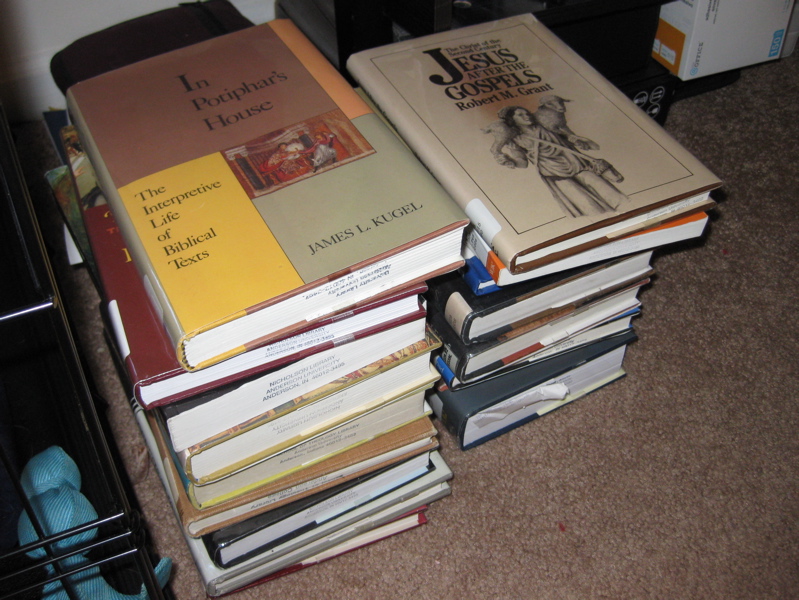
The next “big thing” that will come due for me is an 11-12 page exegesis for Old Testament class, for which I have chosen excerpts from Genesis 39 (the account of Joseph in the house of Potiphar, and especially his involvement with Potiphar’s scandalous wife). I have selected books and commentaries on the topic (see the picture below!), but soon will need to get to work on the actual writing part. I’m sure that later in the month, after the exegesis has been turned in, I will feature a teaser from my findings!

I’ve got books upon books upon books just waiting to be read…

In Church History, we have breezed our way through about eight or nine centuries of Christendom, and have just recently finished a section on monasticism and the “challenge of Islam.” In the week to come, we will be broaching the Middle Ages head-on, including the inquisition and such. I am doing well in this class as well, though I consider it less important than the others.

But one great thing I’m finding about the School of Theology at Anderson University is that I’m relatively free to carve out my own niche, to explore what I want to explore within the context of each class. The term paper for Church History is relatively broad and open; thus I chose the topic of early Jewish-Christian sects of believers, such as the Ebionites, Marcionites, Nazoreans and some of the Gnostics. I am particularly interested in their possible superior application of the message of Jesus than proto-Orthodox groups, especially against the backdrop of the writings of Paul and the Roman Empire’s “institutionalization” of its preferred form of Christianity. This paper isn’t due until after the Old Testament exegesis, so for the time being, it has taken a backseat… though in the pictures posted above, the right-hand stack of books are research I’ve completed for the paper.

Theological Ethics is the class that I was most worried about going into the semester, given that it is a third-year M.Div course and I’m the only first-year in the class. I realize that I could participate more in the class rather than deferring to others, but I scored very high on the mid-term and have gotten good marks for other assignments. It turns out that my fears haven’t been realized! Hallelujah! The discussions and debates we’ve had in class have also been very fulfilling; it has been an honor to learn from the professor and my fellow classmates. There is no major paper in this class, though later in the semester I will have two smaller papers based on some of the ethical case studies we’re assigned.

Apart from the classes, I have also thoroughly enjoyed the camaraderie I’ve felt among fellow students and faculty. While it is difficult at times being a commuting student, even I have experienced the wholesome nature of my education, which in itself has been cognitively stimulating. If Lauren and I are able to move to Anderson next year – which hangs on many, many factors – we are chomping at the bit to do so. But if this doesn’t come to fruition, I still feel that the SOT is a true community, and I consider many fellow seminarians true friends.

******************************************************************

Last night, given her Teach For America connections, Lauren received free tickets to see Waiting for “Superman,” a new documentary about the terrible public education system in our country. It was an eye-opening film, even for this former substitute teacher. But it reminded me that I admire so much Lauren’s passion for early education; she regularly comes home troubled about some aspect of her students’ behavior or performance in class. So many things hold the educational process back, but I affirm the amount of hard work she puts into her underprivileged students. Right now, as I type this, she has been lesson planning for almost five hours with her teaching team, which is a microcosm of the incredible dedication she has for her students. Soon, she may author a guest blog post here about projects she wishes to complete this year from Donors Choose, a website that allows her to seek donors to contribute to specific classroom initiatives.

Well, it seems that my rambling has gone on long enough, and besides, coursework beckons! I do hope it’s not another month before I am able to post again!

“Exterminating Them Without Mercy”

For Old Testament, we students reflect weekly on “some topic, aspect or concept” from the volumes and volumes of assigned reading. I am limited to one single-spaced page each week, and in every case I’ve been forced to cut myself off from writing. So read knowing that my thoughts are manifold!

If you are interested in more selections from my School of Theology Coursework, follow the link to the category of SOT Coursework. I have also set up a new category for these Old Testament reflection papers called OT Weeklies. If all goes well, each new reflection paper will be posted automatically at 2:00 p.m. each Monday, when my Old Testament class convenes.

What follows is my reflection paper from the week of October 11. Enjoy!

————————————————————————————————–

The first half of the Old Testament book of Joshua poses special problems for modern Christians who unequivocally understand God as loving and peace-seeking for all people groups.  Per a straightforward reading of these first twelve chapters, the tribes of Israel march throughout Canaan and are seemingly commanded by God to dispose of anyone they find inhabiting the land.  Referring to a group of kings, the writer of Joshua explains, “For it was the Lord himself who hardened their hearts to wage war against Israel, so that he might destroy them totally, exterminating them without mercy” (Jo 11:20 NIV).  When preaching about the characteristics of Yahweh, most pastors do not include qualities such as “merciless” and “requiring complete annihilation,” yet these are found rather plentifully in Joshua.  This reflection paper will attempt to reconcile such primitive portrayals of God for today’s believers.

Given the significance of these issues, Victor P. Hamilton devotes several pages to a discussion of the Hebrew words kharam and kherem, which lie behind several of God’s apparent requirements for total destruction of “other” peoples in both Joshua and Deuteronomy.  Avoiding the problematic language present in many of the relevant verses, Hamilton explains kherem as “handing something over to God, with no ‘ifs, ands, or buts’ and renouncing of any further claim on the item.”[1] Unfortunately, when that item happens to be land claimed by someone else, those Yahweh-less people often cannot remain alive.  This is not a portrait of the peaceful, loving and forgiving God portrayed in the gospels by Jesus, despite Hamilton’s attempt to pacify by noting that “such wars of extermination” do not “become national policy” for Israel.[2]

Certainly, these apparent conquest accounts are not the only instances of senseless violence in the Old Testament.  Quite graphically, a psalmist in exile speaks favorably toward anyone who would murder Babylonian babies to exact revenge for the fall of Jerusalem (Ps 137:8-9).  Borrowing from medical lexicon, Israel’s xenophobia may be presenting itself symptomatically both in this psalmist’s lament and the kherem commands.  With this frame of mind, is the nationwide predisposition to violence driven by the authentic words of God, or is it merely a reflection of human imperfection?  Or, as Bart D. Ehrman colorfully inquires, “Does [God] really want his followers to splash the brains of their enemies’ infants against the rocks?”[3]

With the benefit of a more matured understanding of God and the good news of Jesus Christ, modern Christians – likely joined by some of the psalmist’s contemporaries – would be unlikely to answer Ehrman’s question in the affirmative.  Perhaps, then, the events and themes recorded in the Bible can be viewed as a chronological progression in the understanding of God’s character.  Brian D. McLaren compares this ever-developing perception of God to the way a schoolchild is introduced to new mathematical concepts as he or she enters new grade levels.[4] For example, whereas all numbers a second grader adds and subtracts are strictly whole and positive, in just a few years, the child will be taught both fractional and negative numerals.  Reasoning for God, McLaren suggests, “What if the best way to create global solidarity is by first creating tribal solidarity and then gradually teaching tribes to extend [that] to ‘the other’?  What if, then, God must first be seen as the God of our tribe and then only later as the God of all tribes?”[5] Only for the slain Anakites might this hypothesis prove insufficient (Jo 11:21-22).


[1] Victor P. Hamilton, Handbook on the Historical Books (Grand Rapids, MI: Baker Academic, 2001), 34.

[2] Ibid., 36.

[3] Bart D. Ehrman, Jesus, Interrupted: Revealing the Hidden Contradictions in the Bible (and Why We Don’t Know About Them) (New York: HarperOne, 2009), 11.

[4] Brian D. McLaren, A New Kind of Christianity: Ten Questions That Are Transforming the Faith (New York: HarperOne, 2010), 103-104.

[5] Ibid., 104.