You may already know that I have hosted Biblical Studies conversations for the New Books Network for a little more than a year, but I was delighted to be invited last month by Dr. Jonathon Lookadoo, a fellow early Christianity and Apostolic Fathers scholar who has also written on The Shepherd of Hermas, to speak about my own book. Our conversation lasted for about 70 minutes and ranged from my background to how I came to specialize in The Shepherd to the ins and outs of my book’s argument both about the nature of Hermas’s message and The Shepherd in the context of the New Testament canon. Listen to our conversation here:
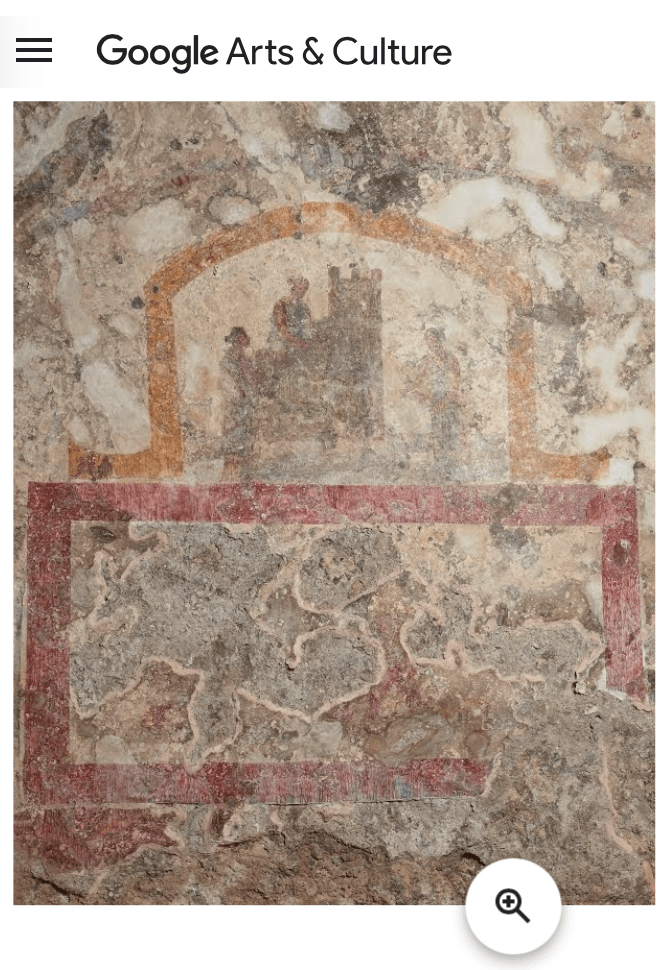
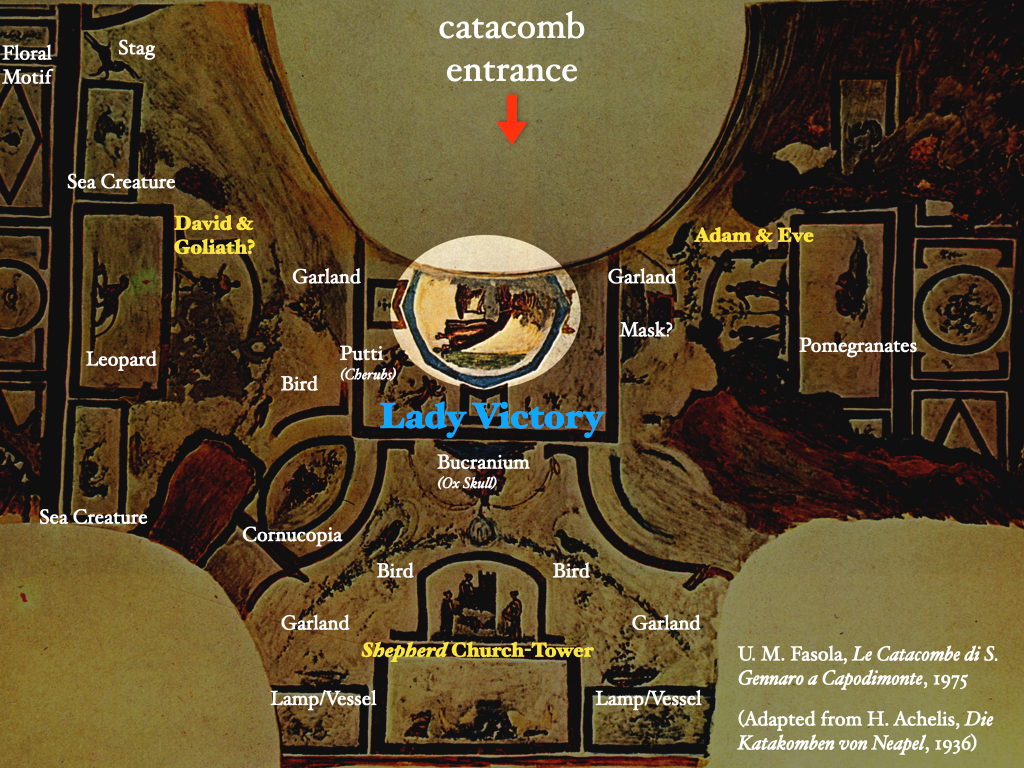
Perhaps the most interesting topic we covered concerned what I called the “anonymous indications” that The Shepherd was a valuable and integral component of early Christian piety. One of these in particular featured my analysis of the Church-Tower fresco (from Vision 3 and Similitude/Parable 9 of The Shepherd) in the San Gennaro Catacombs of Naples, Italy. While you listen to that discussion, it might be worthwhile to view the artwork in question from the third-century cubiculum of the catacombs via Google Arts & Culture, as well as to consider the wider scene depicted on the vault ceiling of “Room A1” as shown below from one of my lecture slides on The Shepherd’s reception in early Christianity. Moreover, you may be interested to “tour,” via Google Maps, the upper vestibule of the San Gennaro Catacombs using the links below.
This fresco from The Shepherd is a unique piece of artwork (a “unicum“) in early Christianity and has suffered from a lack of commentary or elaboration, particularly in English-language scholarship, for what it may suggest about the community that treasured Hermas’s book as authoritative scripture and commissioned its depiction in this sepulchral space. However, appealing to Robin Jensen’s guidelines for “visual exegesis” of early Christian art, I make the case, both in the book and our podcast conversation, that it should be viewed here—much as the Church-Tower functions in The Shepherd more broadly—in an aspirational, salvific context. In other words, we should view the individuals buried in this underground tomb as wishing to become the very stones of the tower, as the Lady Church imparts to Hermas, and to achieve their placement within its mystical structure, perhaps by their embrace of virtuous traits and lives of virtue, as a portrait of their salvation.
Vault ceiling of Room A1, Upper Vestibule of the San Gennaro Catacombs, Naples, Italy (3rd c.). Notice the proximity of the Church-Tower and Adam & Eve to Lady Victory. With its obvious combination of Christian and common Greco-Roman decorative elements, this room represents a transitional stage of the catacomb between an earlier room (A0) containing no Christian imagery and later rooms, like the Crypt of the Bishops, which exclusively memorialize Christian devotion.
I hope you’ll listen to the conversation between Jonathon and me via the embed above or links below, and thanks for reading!
After publishing my book in April 2023 with Lexington Books and posting a Q&A about The Shepherd of Hermas on this very blogspace to accompany it, I let my writing pen fall silent for a while as I was in the midst of some curriculum development, if you will, to teach the New Testament and other topics in early Christianity as capably and currently as possible. However, I wanted to toot my own horn here a little bit about an article that was published in the journal Religion & Theology (Brill) last August as well.
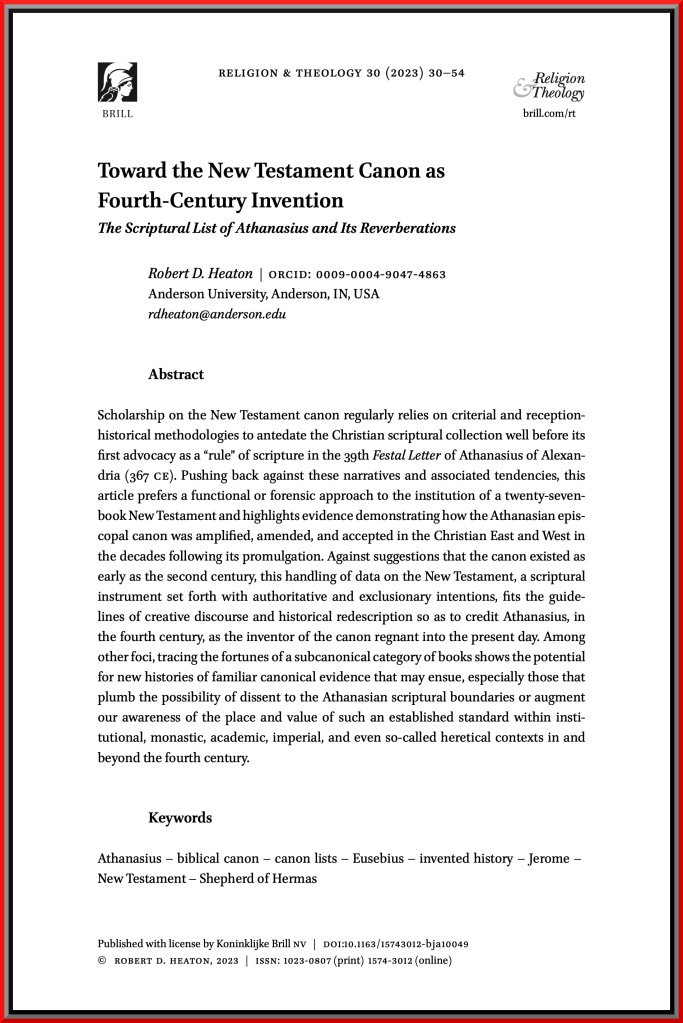
This article (paywalled) is a revamped and expanded version of a paper I gave at the 2022 Annual Meeting of the Society of Biblical Literature, where I was primarily showcasing a chapter of my then not-yet-published book that focused on the evidence we have for Athanasius’s 39th Festal Letter kicking off a discourse that eventuated in the New Testament canon. Fortunately, one of the attendees of that SBL talk invited me to revise my work for publication in this forum alongside some stupendously more advanced scholars than I, like David Eastman and Johannes van Oort. To quote Gerhard van den Heever in his editorial preface to the volume: “What both Van Oort and Heaton demonstrate is that what became known as canonical, orthodox Christian tradition was not a natural occurrence as if sui generis. It was shaped and brought into being through human hands, so to speak” (2).
That focus on human hands, or human agency in the formation of norms and doctrines as we know them, is an appropriate summation of how my work on the New Testament canon has evolved though the lens of the reception of The Shepherd of Hermas. In my book, I rejected argumentation for an unconscious, irrecoverable canon formation on so-called “criterial logic” that has tended to predominate many discussions of that process of development over the last generations of scholarship. This type of explanation of canon formation suggests that books were accepted or rejected on the basis of meeting certain criteria against which they were tested or weighed, such as their orthodoxy, apostolicity, antiquity, and widespread use by the church.
Instead, I sought what I called a “forensic” or “functional” method that left certain breadcrumbs for us to trace in order to say more about the great mystery of the New Testament’s contents. To pursue such juridicial language requires a word of caution or nota bene, which I wrote about in the preface to The Shepherd of Hermas as Scriptura Non Grata (xii-xiii) rather than this Religion & Theology article:
I wish to avoid, of course, the criminological connotation of “forensic,” as if I were looking for the perpetrator of some great injustice. Instead, I was interested to discover an explanation for the exclusion of the Shepherd from the church’s New Testament that accounts for a shift in the trend of the book’s popularity and focuses on individuals, motives, and the acceptance and/or rejection of that decision by others. I believe that “forensic” is an appropriate term for this sort of investigation.
Peasant Hermas and his Angelic Shepherd
Essentially, I appeal to the etymology of “forensic”: something that can be tested, reasoned out, or “heard” in a public forum. But whereas my book foregrounded The Shepherd of Hermas and ultimately came to the subject of canon by means of the vestiges of its reception history into the fourth century, this article instead tried to make a claim about the formation of the NT canon by reflection on the fate of The Shepherd, as I say, if we are willing to let The Shepherd be our guide to the canon.
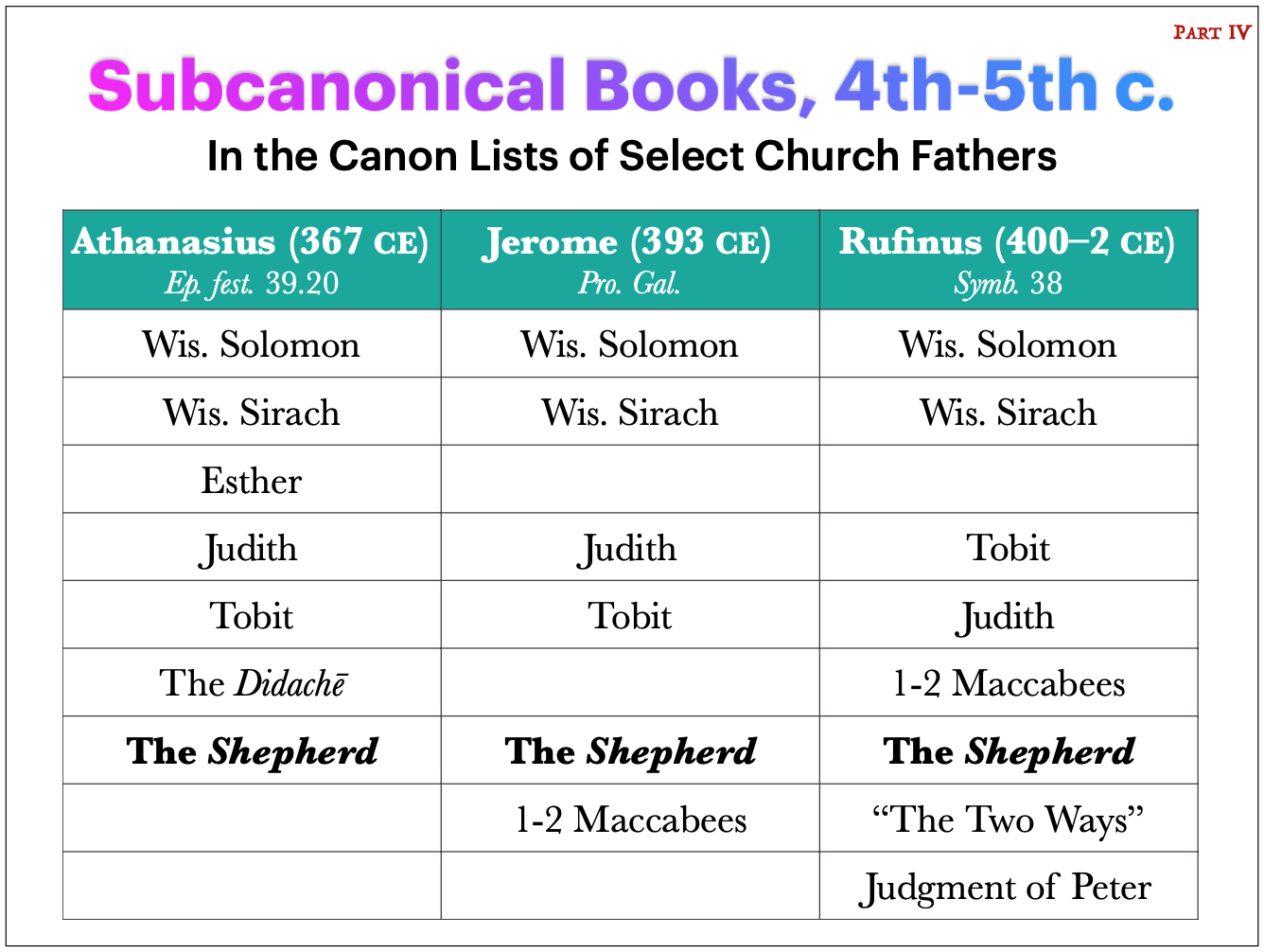
Athanasius, of course, is the key figure in this equation, for not only does his 39th Festal Letter (367 CE) contain the first list of the twenty-seven books that comprise our New Testament, but he also sidelines The Shepherd into a subcanonical category of what for him are catechetical books, able to be read to/by neophyte Christian initiates but not appealed to for the formation (or substantiation) of Christian doctrine. (Some eight or nine years prior to this, he had also declared The Shepherd to be not “of the canon” in his Defense of the Nicene Definition of Christology.) Fortunately, not only does Athanasius’s canon list achieve a sort of translocal usage via the translational work and erudition of Jerome, but so too does his subcanonical list, in a slightly altered fashion that yet reveals its genealogical link to the anti-Arian, pro-Nicene Alexandrian bishop.
Slide from one of my NT canon lectures; see also Table 1 in the article, pg. 47.
Thus, whatever we may make of Eusebius’s pioneering scriptural list in Hist. eccl. 3.25 and other prior indications that Christians were attempting to restrict their authoritative scriptures before Athanasius, their work is, as I describe it, a bit of “noise” that distracts us from the church’s true accession to a canon in the heat of internecine theological battles of the late fourth century. I will leave the rest of the argument to be discovered in my article, and only wish to lament one error of terminology that I failed to catch before publication, on pg. 50: please read “filial” as “fraternal”!
The article’s abstract follows:
Scholarship on the New Testament canon regularly relies on criterial and reception-historical methodologies to antedate the Christian scriptural collection well before its first advocacy as a “rule” of scripture in the 39th Festal Letter of Athanasius of Alexandria (367 CE). Pushing back against these narratives and associated tendencies, this article prefers a functional or forensic approach to the institution of a twenty-seven-book New Testament and highlights evidence demonstrating how the Athanasian episcopal canon was amplified, amended, and accepted in the Christian East and West in the decades following its promulgation. Against suggestions that the canon existed as early as the second century, this handling of data on the New Testament, a scriptural instrument set forth with authoritative and exclusionary intentions, fits the guidelines of creative discourse and historical redescription so as to credit Athanasius, in the fourth century, as the inventor of the canon regnant into the present day. Among other foci, tracing the fortunes of a subcanonical category of books shows the potential for new histories of familiar canonical evidence that may ensue, especially those that plumb the possibility of dissent to the Athanasian scriptural boundaries or augment our awareness of the place and value of such an established standard within institutional, monastic, academic, imperial, and even so-called heretical contexts in and beyond the fourth century.
Robert D. Heaton, “Toward the New Testament Canon as Fourth-Century Invention: The Scriptural List of Athanasius and Its Reverberations,” Religion & Theology 30.1-2 (2023): 30–54. https://doi.org/10.1163/15743012-bja10049.

 Robert D. Heaton, Ph.D.