The Journey from Anderson to Haifa

While tweeting about the banalities of my journey from my home in Anderson to my first hotel in Haifa, I had been using the hashtag #38HoursToIsrael without much precise calculation. As it turns out, my rough calculation was just a little bit short: adjusted for the time zone difference, Lauren and I disembarked our apartment at 2:45 pm Thursday (Israel time), and I was dropped off at the Hotel Beth Shalom at 6:15 am Saturday. So if my math is correct, total running time: 40 hours, 30 minutes.

Well over half of that time was spent sitting down somewhere, and a very small minority of that time was spent asleep. That being said, this is not a post of complaints. I chose one of the lowest airfares I could find knowing well that I had a lengthy layover in Warsaw, and furthermore that I would land in Israel two calendar days after my departure.

For all the deliberation over taking a Greyhound bus to Chicago, this ended up being one of the more spacious, painless and productive parts of my travel. While the bus’ promised WiFi was not operational, I was able to churn out the better parts of three separate blog posts. And the connection from the Chicago Greyhound station to O’Hare was equally painless: just a three-block walk and I was on the blue line, the destination of which was the airport itself.

My flight to Warsaw was delayed by approximately three hours; I didn’t ask for a reason and none was given (I later learned that the plane, which had flown the exact same route in reverse, was itself late). Once we took off for the nine-hour flight, my luck was not much better: a wailing baby across the aisle from me, coupled with a man in the seat to my right who had a penchant for falling asleep over his Kindle with the bright overhead reading lamp distinctly ON, reduced my shut-eye time to very short naps.

Because of the flight’s delay, my half-day tour of Warsaw (scheduled for 2:00 pm) was in real jeopardy. Instead of landing at around 10:00 am with plenty of time to spare, we landed at 12:40 pm. Thankfully, passport control was a breeze and I also was quickly able to find an ATM to withdraw some Polish złotys. Thus began my search for a taxi.

If this endeavor in blogville is to be comprehensive, it must include both my successes and failures as a first-time international traveler. Here is my first failure, then: I followed a Polish man who offered a “taxi,” but who really was just an ordinary person who parked at the airport and waited to find some gullible bloke like myself. As we walked to his car, I came to realize my error, but he said he could get me to the location of my tour on time, so I continued on. Thankfully, this mistake only cost me about $13 over and above the rate of a legitimate taxi, rather than bodily injury (or worse). And as it turned out, I made it to my destination at 1:53 pm, with seven minutes to spare. Mission accomplished, even though I was taken for a ride.

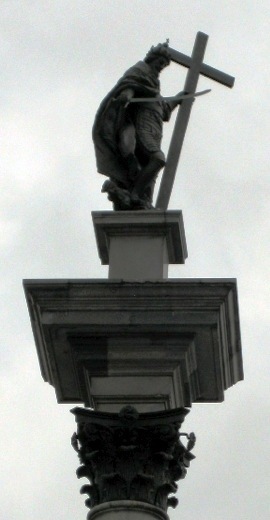
The tour of Warsaw was very enjoyable, and I snapped a number of great photos of the various parks, monuments, statues, and so forth. Sadly, I was unable to photograph the various memorials related to the Jewish Ghetto, the Jewish uprising of 1943, etc., as I was both on the wrong side of the van and some of them were within a fenced construction zone, as a Jewish museum is presently in the works. Perhaps the most striking thing about the entire tour was how deeply sown-in violent, armed conflict the entire history of the city is. From wars of the 16th-19th centuries to World War II, almost every monument is dedicated to the remembrance (or glorification, unfortunately) of victories, defeats, bloodshed, lives lost, battles won, etc. In numerous cases, the cross of Christ and the sword are inexorably linked and equated. With greater reflection, perhaps I will be able to understand how I can paradoxically recall the tour both as “very enjoyable” and emotionally, philosophically uncomforting.
20120624-121532.jpg
Cross in one hand, sword in the other.

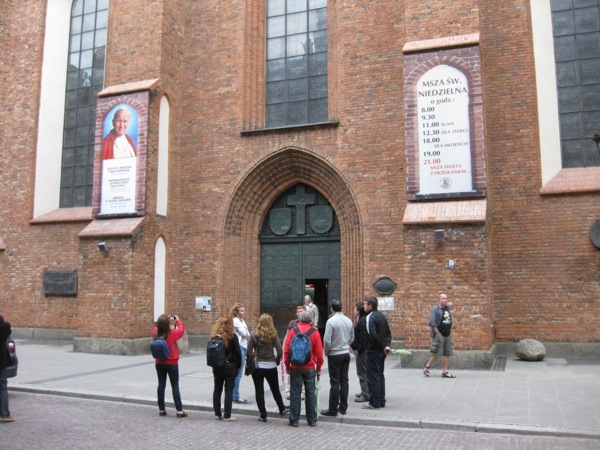
The tour came to a close after a walk through the Old Town, which, like much of Warsaw, was completely destroyed during World War II and later reconstructed. Many buildings in the area display two dates: not a timespan, but the dates of initial construction and reconstruction after the war. A prominent example of this is a Catholic church located in the Old Town, a photograph of which is below.
20120624-121049.jpg
The Catholic church, mentioned above.

20120624-120714.jpg
Constructed 1370, reconstructed 1956. See more photos from Warsaw.

One of the more helpless feelings of the journey came next. After knowing I had paid about double the rate to get from the airport to downtown on my “taxi,” I didn’t want to pay the taxi premium again. I decided to take a bus back to the airport, which, given my lack of understanding of Polish, was a real zoo. (Though to some degree or another I understand German, French, Spanish, Hebrew and Greek, Polish was like real alphabet soup to me.) At the ticket kiosk I was asked a number of questions to which I didn’t know the answer, and I just ended up buying a bus ticket for something around the fare of three to four złotys, which my tour guide had estimated. Thankfully, there was no one on my bus examining tickets for the entire ride to the airport!

Compared with the wait through security in Chicago, after which I lost both my sunscreen and my jar of Nutella (major frown), the security point in Warsaw was very painless. I noticed the man watching the x-ray scanner saying something in Polish about my backpack, but no further inspection occurred.

The wait in Warsaw was very long, and we were put in a maximum security, show-your-passport-and-boarding-pass-to-everyone-who-asks gate. But I did manage to recognize a fellow passenger from the Chicago flight that landed some 8 hours earlier, and we had a good chat while waiting several hours for departure. Her name was Mary, and it was her first trip to Israel as well. (Turns out she came for a wedding.) Like me, she also left the airport for a (different) tour of Warsaw, so we compared stories and the like. I won’t lie, it was kinda nice not being the only obvious American on the plane.

By the time we boarded, I was very exhausted, and I fell asleep shortly after takeoff, along with the great majority of other passengers. I appreciated that the flight attendants tucked a sandwich for me in the pocket in front of my seat; it would later come in very handy while waiting for my hotel to open.

Departing the plane, I was immediately pulled aside and questioned by security (I must’ve stood out from the other passengers, being both pasty white and traveling solo). Despite my 4:00 am, 38-hours-into-my-journey grogginess, I answered the woman’s questions rather well, and I was soon on my way. I think part of this is because this was unexpected; Passport Control was another story. The woman there was more confrontational, and I got somewhat flustered. I was allowed to pass, but was recommended for further questioning by a manager. His demeanor was friendly but stern (“So you are an archaeologist?” “Well, no, but I am a student with aspirations…”). Anyway, apparently I must have sounded at first like I came to Israel to do archaeology completely on my own. I was allowed to go on my way when I explained that I came as part of a program through the Hebrew University. Once I showed him my acceptance paperwork from the university, I received the much appreciated “Welcome to Israel.”

At this point, I followed the same drill as in Warsaw: get money from the ATM, and get a taxi. Thankfully, I had a better (and more specific) idea about what I was looking for: a Sherut, or shared taxi with 8 or 9 other people going to the same city. This way, what would have been a large fare for a one-hour ride became small. I was the eighth passenger on the van to Haifa, and when the driver found a ninth and a tenth, we departed. (Here I also turned down a random man offering me “taxi.”)

I stayed awake on the Sherut, mostly because I wanted to see what Israel proper was like. First impressions: there is construction everywhere! Look almost in any direction and you’ll see cranes, scaffolding, and construction zones galore. Also, there are more American businesses than I expected to see. Yes, I knew I would see plenty of McDonald’s. I didn’t know I would also see Office Depots. While on the Sherut, the sun rose and night became morning, and after dropping off 5 or 6 other passengers, I reached the Hotel Beth Shalom at 6:15 am local time. The hotel was closed, but a guest who was reading in the lobby opened the door for me. I was allowed to check in at 7:00, despite the official check-in time being noon. Toda raba, Sana!

Thus ended my travel to Israel, but in truth, the journey is just now starting. If you’ve made it this far, thanks for reading.

*********************************

I connected again with Lauren, before sleeping for 8 hours. I meant to wake up at noon, but didn’t until 6:20 pm. (Oops.) Then I went out to see some of Haifa…

20120624-122108.jpg
Lower Haifa viewed from the Louis Promenade. See more photos from Haifa.

Now, I am on a bus from Haifa to Rosh Pina in Galilee. Soon I will meet up with the dig group from the Hebrew University. Shalom for now.

PSA: How to View My Photostream

Just a quick update for now! First, I’ve made it to Haifa in Israel after some thirty-eight hours of transit. A blog post about the journey and my day trip in Warsaw is in order, but for now this news must suffice.

Second: I’ve created a Flickr Photostream where I’ll be able to post most, if not all, of the great photos I take over the next 5 weeks. I’ll still feature the best of the best on the blog (such as Old Town Warsaw, below), but for the greater collection of pics, consider bookmarking that link!

20120623-085432.jpg
Old Town Warsaw

The Road To Israel, Part 2: Why We Dig

My departure for Israel is fast approaching, and given the groundswell of interest in my trip, I decided to create a three-part series to provide more information about what exactly I’ll be doing there. Part one covered basic facts about the history of Hazor, while part two covers the intentions and goals of modern archaeology (especially for biblical sites). Part three, tentatively, will feature some ideas and details about my journey around Israel once my three-week excavation is complete. (See also, my basic itinerary.) So, let’s dig in, shall we?

***********************************

Leave it to my grandma to ask the most basic, fundamental question imaginable after I announced that I would be traveling thousands of miles to participate in the excavation at Hazor: What on earth are you digging for?

Sometimes I tend to forget that not everyone is a student in biblical studies. The question seemed so preposterous to me, but the more I thought about it, the more sense it made, both in terms of material items we hope to find and the intentionality behind excavations.

In his 2002 autobiography Doors to Life, Dr. Gustav Jeeninga (the late professor for whom my fellowship is named) defines archaeological data as “human thought objectified and then fossilized.” If you ask me, this is a fantastic definition. Archaeology, then, becomes an endeavor not to uncover ancient writing samples, intact pottery or elaborate municipal structures, though the discovery of such items is certainly rewarding and of principal importance to academia. Rather, we seek these material objects only as clues to the ideas of cultures long left dormant and livelihoods of people long silenced. And specifically in regard to the Ancient Near East, our secondary interests include affirming the biblical record (or, at times, weighing the evidence against the biblical record) and attempting to fill its gaps. Such is the case for Hazor, a biblical town for which the gaps are numerous.

With Dr. Jeeninga’s definition in mind, we must note that we can only access this “fossilized human thought” through physical objects. The simple answer to my grandma’s question, in a material sense, is that we’re searching for whatever we might find. But certain items will be more valuable than others. Any objects containing writing will provide the most direct access to the ideas, needs, intentions, and daily life of the ancient people of Hazor, but it will be extremely unlikely to find writing on any intact items. More than likely, we could find writing on broken pieces of pottery or the ruins of old structures.

Pile of Potsherds
Potsherds: think of them like the garbage of the ancients.

At this point, it is necessary to explain a little bit about how cities were built, conquered and rebuilt over in the Ancient Near East. When people first settled a location, much like the North American settlers of the 17th century, location was everything. For the purpose of protecting a settlement from military bombardment, the highest points were often chosen for fortification. In some cases, these high points may not be any more than a hill or a mound (which we call tels), as opposed to a mountain or plateau, but any advantage the people could grab would be vital for security from adversaries. When a town would be overrun and rebuilt with frequency, new settlers–who were accustomed to first destroying or plundering everything of value from a previous settlement–would simply build on top of that previous settlement, either with completely new structures, or by incorporating the previous structures into their (perhaps only slightly) different vision for what civilization should look like.

As a result, there are two significant observations about doing archaeology at biblical sites that I should stress. First, with the exception of physical structures, which, if not destroyed by military edict, are easily preserved over time because of their intentional construction, we are digging through ancient peoples’ trash. Hazor is not Pompeii; the entire town was not flash-fossilized for posterity. It was conquered and plundered violently, and its new occupants would not have consciously built over items they regarded as valuables.

A second observation is that when you dig deeper and deeper at a location, you access more and more ancient strata of livelihood. Because the Hebrew University has sponsored excavations at Hazor for more than 20 seasons (usually six-week periods in the summertime), my dig will be exploring the 13th and 14th centuries BCE, which theoretically should not include any distinctly Israelite settlement. This is appropriately called the Canaanite Period, as it is associated with the time in which scholars believe Joshua wrote that Hazor stood as “the head of all those kingdoms” (Joshua 11:10 NRSV).

What is typically found when rummaging through ancient trash is pottery, pottery, and more pottery. Shattered pottery, mostly. If we’re lucky, we’ll find large pieces of pottery that can be later reconstructed and studied to understand its precise utility to the civilization. Pottery was also the paper of the day, so we will be highly interested in any engraving that we may find on the sherds of pottery. We could find anything from ancient business contracts to royal decrees to scribal alphabet writing practice!

Other items we may find include both municipal and private structures, human and animal remains, oil lamps, weapons, coinage, and deities (idols). In addition to preserved writing, these items would constitute the real gold of the excavation and, if found, will necessitate several pages of ink in the end-of-season report.

So as I’ve come to understand, though we dig for physical objects, we are simultaneously (and primarily) digging to learn more about ancient people who can no longer speak for themselves. We wish to understand their way of life, their beliefs, what they beheld as important, how they met their end, and, ultimately, what we can learn about our humanity from their activity and their temporality. In short, we dig to grant ancient peoples a voice.

The Road To Israel, Part 1: All About Hazor

My departure for Israel is fast approaching, and given the groundswell of interest in my trip, I decided to create a three-part series to provide more information about what exactly I’ll be doing there. Part one covers basic facts about Hazor, while part two will cover the intentions and goals of modern archaeology (especially for biblical sites). Part three, tentatively, will feature some ideas and details about my journey around Israel once my three-week excavation is complete. (See also, my basic itinerary.) So, let’s dig in, shall we?

***********************************

Archaeological Hazor
Welcome to Hazor, the archaeological site where I’ll be digging. Photo courtesy of the Hebrew University.

Pronunciation of “Hazor”: HOTS-or (not HAY-zore or HA-zore!). Though Hazor is spelled in English with a z, this letter in Hebrew is a “sade,” which is vocalized like a “ts” digraph.

Location of Hazor: Hazor is situated roughly 10 miles north of the Sea of Galilee along what was a significant ancient pass into and out of the northern kingdom of Israel. Its relative distance from the heart of Israel, let alone the land of Judah or Jerusalem, made it somewhat of a forgettable city—at least as far as the biblical record is concerned. Whenever Israel happened to face a powerful enemy from the north, Hazor stood immediately along the firing line. Along with Dan, which is recognized as the northernmost distinctly Israelite settlement, Hazor is often found in lists of cities destroyed when wars would break out between nations.

Hazor Map
This map of Ancient Israel is adapted from the American Bible Society. I’ve added a red arrow pointing to Hazor!

Biblically Speaking, What is Known About Hazor?: Knowing that it could also be a stalwart protecting against attacks from the north, Hazor’s location and relative vulnerability led King Solomon to strengthen and fortify part of the city in the 10th century BCE (1 Kings 9:15). Earlier, the city was said to be entirely destroyed by the conquest of Joshua (Joshua 11:10-15), and it also served as the home base for the Canaanite King Jabin (Judges 4:2). After Solomon’s time, Hazor would be among the numerous cities overrun by Tiglath-pileser of Assyria (2 Kings 15:29). Later, Jeremiah would warn about Hazor’s destruction at Babylonian hands, prophesying, “Hazor shall become a lair of jackals, an everlasting waste; no one shall live there, nor shall anyone settle in it” (Jer 49:33 NRSV). Though Jeremiah’s message rang true—Hazor is thereafter mentioned only as a battle site in the apocryphal book of 1 Maccabees—the site is today much more than an eternal wasteland. In fact, it is one of the largest and best preserved archaeological sites in Israel today.

Archaeologically Speaking, What Else Is Known About Hazor?: Though our biblical knowledge of Hazor is relatively limited to its continued destruction and fortification over the centuries, archaeology helps to fill in the details and, as much as is possible after the passage of time, give its residents a voice. We know that Hazor contained both an “upper city” and “lower city,” though both parts of the city were not always inhabited at the same time. In Solomon’s time, for example, the archaeological record tells us that only one half of the upper city was actively settled. Additionally, while Hazor has the remains of a Yahwistic cultic high-place, archaeologists have also found pagan religious symbols and structures. This raises an important question, specifically, how Israelite was Hazor?

Perhaps most significantly, by the time of Solomon we know that Hazor was well in decline. The city’s best years, during the second millennium BCE when it enjoyed a population of perhaps 20,000, were well behind it. Though Hazor is somewhat of an afterthought in the biblical record, its Canaanite significance is not questioned. Joshua 11:10 alludes to this, saying, “Before that time Hazor was the head of all those kingdoms” (NRSV).

Portions of this section, and this post as a whole, are adapted from the Hebrew University of Jerusalem’s Hazor historical website; clickthrough to read more about how Hazor is mentioned in documents even older than the Bible! The dig in which I will soon participate is led by the Hebrew University, and you can also read recent seasons’ reports from their site.

Reasons for Choosing Hazor: When researching various digs taking place this summer, I decided I wanted to participate in an established dig with a respected university at a location with which I was (at least vaguely) familiar, and could therefore be connected with my studies in Old and New Testament. Hazor fulfills all of those requirements. The intrigue provided by the Canaanite/Israelite question—by which I mean, was there indeed continuous violent destruction or perhaps cohabitation and coexistence, and when?—and the archaeological significance of Hazor sealed the deal. With all I now know, I’m thoroughly looking forward to the dig!

Later this week, I will continue with a post about the reasons for archaeology, how excavations are undertaken, and much more. I hope it will provide more insight about what exactly I’ll be doing at Hazor, now that you know some basics about its history! Got any more questions or thoughts related specifically to Hazor? Feel free to leave them in the comments section, and I’ll answer them to the best of my ability!

Counting Down to Israel: T Minus One Month

Before I begin with the topic of this post, Happy New Year! Yes I know, the calendar year is coming upon one-half gone, but it’s actually my first blog post of 2012. Oops! Now that the spring semester is long gone, perhaps I should try to rectify that by recounting my recent studies and other things I’ve been working on.

But as the title alludes, it is now one month to the day until I depart the familiarity of the United States for the adventure and exploration of Israel. In the past weeks I have finalized a number of plans that have made the trip begin to feel real. For those interested, here is a rough outline of my plans:

Tel Hazor Map
Hazor lies north of Chinnereth and the Sea of Galilee in Israel, as shown in this map from bibleatlas.org.

June 20-21: One-day vacation in Chicago with Lauren.
June 21: Depart from Chicago for Warsaw, Poland.
June 22: Thirteen hour layover (and mini-vacation!) in Warsaw; depart for Tel Aviv in the p.m.
June 23: Arrive in Tel Aviv in the wee hours of the morning, spend night nearby.
June 24: Travel north to Hazor and report to kibbutz (camp) for the dig to begin the following morning.
June 25-July 13: Excavation begins at 5:00 a.m. and lasts until 1:00 p.m. every weekday. On the weekends, I’ll have the opportunity to plan some day trips with my compatriots.
July 14-25: The dig will continue, but I will begin the recreation and sightseeing portion of my trip. I’ve booked accommodations deep within the Old City of Jerusalem, in a convent run by French nuns! So I’ll spend my nights in Jerusalem, but during the daytime I’ll travel around Israel, from Capernaum and other sites in the Galilee to Beersheba in the south, and hopefully everywhere in between.
July 26: Early flight home retracing my earlier route, from Tel Aviv to Warsaw and back to Chicago.

So, my trip will be jam-packed with adventure and new experiences (and I will certainly add more details to those rough plans in the near future, including what I’ll be digging for, who I’ll be working with, etc.!). I plan to chronicle as much of the trip as humanly possible on the blog, using written articles, photos and perhaps even videos, so if the trip sounds interesting to you, it might behoove you to subscribe to the blog for the next few months! You can do so by scrolling down along the right sidebar of this page, submitting your email address, and clicking on the “Sign me up!” button. If you do so, you will receive an email from my blog each time I publish a new post! You can unsubscribe at any time, so what do you have to lose?

One more thing: you might recall that last year I attempted to raise funds from friends and family for this trip (which would have then taken place in summer 2011), before ultimately deciding that I would not have a sufficient amount. This year, since I was awarded a fellowship in archaeology from my school’s Jeeninga Museum for Bible and Near Eastern Studies, I determined that running a dedicated fundraising effort would not be necessary, since the fellowship more than covers the costs of my flight, dig program, etc. However, some family and friends have sent me contributions anyway, and I am very thankful for them!

That’s all for now, thanks for reading!